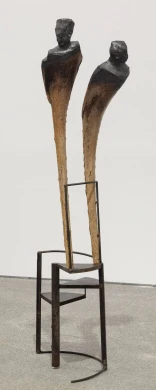
Baranda de Alcamé (Handrail of Alcamé)
- Date
1984
- Technique
- Welding
- Materia
Palm tree wood, steel, papier mâché and paint
- Dimensions
- 170,7 x 65 x 41,5 cm
- Year of entry
- 2014
- Registration number
- DO01996
- Credit
Long-term loan of Fundación Museo Reina Sofía, 2014 (Donation of Patricia Phelps de Cisneros)
Juan Muñoz is the most internationally recognised Spanish artist of the 1980s and 1990s. After training in London and New York and an early stint as a curator, in 1984 he held his first solo show at Madrid’s Fernando Vijande Gallery, entitled Últimos trabajos (Latest Works). Some of the predominant themes comprising his iconography — staircases, balconies and minarets — appeared for the first time in that show. Critic José Luis Brea used Juan Muñoz’s work (along with that of Cristina Iglesias) as an example of new artistic practices that addressed the concepts of subjectivity and
representation.
Baranda de Alcamé belongs to his first show and is a variation on his watchtowers, with two eyeless humanoid figures made from palm wood. Twisting around a spiral staircase, the figures turn as the viewer passes by, warning of their presence, but their blindness is unsettling due to the impossibility of recognition: a strange feeling of unease in the face of danger.
The title refers to a biographical anecdote — a balcony at the home of a Portuguese artist friend, Julião Sarmento. However, as Juan Muñoz himself stated, ‘I construct [...] works to explain to myself things that I cannot understand in any other way. In some way, the work must remain enigmatic to me’.
Carmen Fernández Aparicio