Guernica
- Date
1992
- Edition number
Unlimited
- Duration
75 min. 76 sec.
- Color
Colour
- Sound
Sound
- Year of entry
- 2011
- Registration number
- AD06486
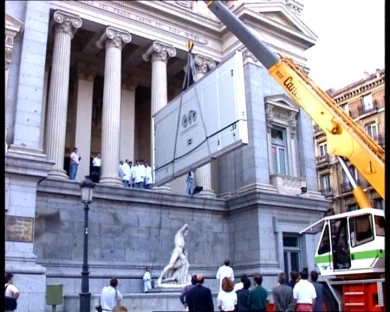
Visual artist and filmmaker Tino Calabuig used the documentary genre as a tool for social criticism and political engagement; a prime example of this is his film La ciudad es nuestra (The City Is Ours, 1975). He also used this genre to record one of the central milestones in the history of the newly created museum: from his street-level perspective, he chronicled the transfer of Guernica from the Casón del Buen Retiro to the Museo Nacional Centro de Arte Reina Sofía, MNCARS (Reina Sofía National Museum Art Centre) in 1992. With an intimate, direct gaze, Calabuig captures the street sounds, the event’s media coverage and the authorities’ attendance, led by the Spanish Minister for Culture at the time, Jordi Solé Tura, and the museum’s director, María Corral. Guernica’s transfer marked the consolidation of a change in cultural policy that had begun the decade before, becoming an emblem of openness to society and the process of institutional modernisation. The museum sees Guernica as a focal point for building and organising its collections; from the outset, the piece would enter into dialogue with other contemporary artists. The transfer became part of a process of reorganising the Prado Museum’s and MNCARS’ permanent collections, culminating in the Spanish Royal Decree of 1995, which established the year of Pablo Picasso’s birth (1881) as the dividing line between the two collections. To protect the painting during transportation, a custom-made crate was built to prevent the canvas from rolling up, while a special vehicle was adapted to transport it and a specific lift constructed to install it in the museum.
Joaquín Merlos Isidro.