-
24 March, 2014
Luchino Visconti. Rocco and His Brothers
Film, 1960. Projection format: 35mm. Original Version, Subtitled. 168’
Rosebud Films, Madrid
The Parondi family arrive in Milan. Following the death of the father, they leave their town, Luciana, in southern Italy, so the sons can find work in the big city. The script was first devised as a novel, and after an introduction called The Mother (which wasn’t filmed), the plot is weaved together over five chapters, each one named after one of the five sons (Vincenzo, Simone, Rocco, Ciro, Luca). -
26 March, 2014
Ritwik Ghatak. Subarnarekha
Film, 1962. Projection format: 35mm. Original Version, Subtitled. 143’
British Film Institute, LondonA native to East Bengal, Ghatak forms part of the millions of refugees that were forced to return to Calcutta when India's Declaration of Independence gave rise to the creation of Pakistan, in 1947. Subarnarekha (1962) is, together with The Hidden Star (1960) and Komal Gandhar (1961), the third part of the so-called Partition Trilogy. Of the three films, Subarnarekha is the most lyrical and the one that most radically condenses the metaphors of Partition: History interrupted, escape and betrayal.
-
31 March, 2014
Nelson Pereira dos Santos. Barren Lives
Film, 1963. Projection format: DVD. 103’
Regina Filmes, Rio de JaneiroAs the title itself intimates, the geographical and social conditions determine a way of life and storytelling. A family of farmers are uprooted from their home because of a drought and cross through the country's interior, the sertao (or dry hinterland), on foot. Luckily the rain enables them to stop for a while in a fazenda (farm). The head of the family, Fabiano, is a victim of police persecution and is imprisoned and beaten. He later meets his tormentor, alone, but refuses to seek vengeance. The family set off once again as they search for means of survival.
-
2 April, 2014
Djibril Diop Mambéty. Touki Bouki
Film, 1973. Projection format: Digibeta. Original Version, Subtitled. 89’
Copy from the Foundazione Cineteca di Bologna, restored in 2009 by the World Cinema Project in the Cineteca di Bologna/Laboratorio L’Immagine Ritrovata
Rights Maag Daan Crossmedia, Dakar
Touki Bouki prolongs the tension between a pastoral world and the conditions of urban living, yet also marks a turning point. The politicisation of African cinema went hand in hand with national liberation movements, utilizing Marxist critique of the imperialist domination. Mambéty’s inspiration comes not only from the Nouvelle Vague, but also eccentric forms regarding norms of political cinema. Touki Bouki transforms a biographical drama into fable, halfway between lyricism and parody, but does not end with a lesson in morality. -
7 April, 2014
Robert Kramer and John Douglas. Milestones
Film, 1975. Projection format: 35mm. Original Version, Subtitled. 195’
Copy restored in 2008
Capricci Films, Nantes
Milestones is an immersion in and a stroll around the America of counter cultures in the period that follows the US defeat in Vietnam, with an armistice being signed in 1973. The film is a documentary assemblage blended with sequences of drama, a kaleidoscope of life situations, often accompanied by monologues or long conversations. Within this palimpsest Milestones demonstrates how cinema continues to work on its own emancipation, despite the connection with social struggles being broken. -
9 April, 2014
Chantal Akerman. News from Home
Film, 1976. Projection format: DVD. Original Version, Subtitled. 85’
Paradise Films, Brussels
News from Home describes an autobiographical situation. A young woman living in New York receives news of her family in Brussels. She reads her mother’s letters aloud in a monotonous litany; the voice-over of the reader, at times drowned out by the sounds of traffic, is inserted at regular intervals in a montage of static and long panoramic shots. A distant day-to-day expressed in simple and stereotyped language, with no literary quality, interacts with the contemplative images of Manhattan taken by Babette Mangolte. -
21 April, 2014
Rithy Panh. Site 2
Film, 1989. Projection format: Digibeta. Original Version, Subtitled. 92’
JBA Production, Paris
Yim Om talks about her life from a Cambodian refugee camp on the Thai border; she says: This month, in the cold season, I feel nostalgia for our town, where we lived in freedom. Deep down we only think about this, without knowing who to tell it to. Site 2, Rithy Panh’s first film, shows a broken and disorientated life that is given back some direction by the story and piercing voice narrating it. -
23 April, 2014
Amos Gitai. Wadi 1981-1991
Film, 1991. Projection format: Blu-Ray. Original Version, Subtitled. 97’
Agav Films, Paris
The first Wadi was filmed in 1981 in one of the (wadi) valleys that characterises the site of Haifa, the film-maker’s home city. Wadi Rushmia is an old stone quarry that, despite being abandoned in the 1940s, is still invaded, this time at the beginning of the 1980s by a heterogeneous and marginalised community; the first film describes this living enclave. Gitai returned to these places ten years later. Composed of these two visits, Wadi 1981-1991 joins fragmented life stories that reveal the complex, and often invisible, coexistence between Jewish and Palestinian communities. -
28 April, 2014
Pedro Costa. In Vanda’s Room
Film, 2000. Projection format: Betacam. Original Version, Subtitled. 170’
Courtesy of the director and Optec, Lisbon
The room invaded by the camera is the refuge of a young drug addict called Vanda, inside the family home in a working-class neighbourhood in Lisbon that is being demolished. The young woman’s self-destruction corresponds to the destruction of the area around her, Fontainhas, and was filmed using static shots that appear to withstand the demolition. But these shots are unstable and subjected to the slightest stirrings of the character and the environment. The present resists while on the verge of catastrophe, on the threshold of extinction. -
30 April, 2014
Mati Diop. Mille soleils
Film, 2013. Projection format: Blu-Ray. Original Version, Subtitled. 45’
Cinenomada
The film begins with the image of a herd of horned cows, at a crossroads in Dakar, led by an old man. Mati Diop is the niece of Djibril Diop Mambéty, who died in 1998. Forty years on from the filming of Touki Bouki, the film-maker meets the two actors and and finds that both have followed their character’s destiny. Mille soleils combines a kind of elegy with elements of social documentary.
Moments in Life. Biography in Film Discourse (1960-2013)

Held on 24, 26, 31 Mar, 02, 07, 09, 21, 23, 28, 30 Apr 2014
This film program shows the diversity of biographical situations, individual and collective situations addressed in cinema since the early 1960s. The programming, of an historical nature, links the transformation of biographical forms to a history of cinematic memory as the ten films reflect three time periods. The last, Mille soleils (A Thousand Suns, 2013), adds the recollection of a film from the second period – the legendary Touki Bouki (1973) – in a retrospective examination governed by a link to kinship.
The screenings begin with Luchino Visconti’s Rocco and His Brothers, first shown in 1960. At a point that shifts decisively towards the Nouvelle Vague, the Brazilian film-maker Glauber Rocha displaces the angle of approach: through Rocco, Visconti adds a chapter to the controversial film versus fiction, conferring the dimension of the novel on the world of cinema. Thus, Rocha related the grand form of cinematic drama to the condition of the wretched of the Earth (the eponymous book by Frantz Fanon that appeared in the same year), in other words, to a multitude of lives without biography. Subarnarekha, by Bengali film-maker Ritwik Ghatak, the film Barren Lives, by Brazil’s Nelson Pereira dos Santos, and Touki Bouki by Senegalese film-maker Djibril Diop Mambéty, respond and correspond to Rocha’s position, as well as questions raised by Visconti.
A life without properties, in its double meaning without ties or a way out, which cannot be told or transformed in a coherent account, comprises the second period. The collapse of a large collective project brings about a similar effect of loss and expropriation. In 1975 in the United States, Milestones, a film by Robert Kramer and John Douglas, takes stock, in a somewhat disillusioned way, of the militant paths that were formed during the social movement struggles against Vietnam war. The intimate and dedramatised News from Home (1976) complements Milestones, with Chantal Akerman, who had gone to live in New York, giving voice to her mother’s repetitive letters.
Rithy Panh, Amos Gitai and Pedro Costa make up the third historical sequence. The documentary Site 2 dates back to the year of the fall of the Berlin Wall. A female Cambodian refugee that flees from Pol Pot’s regime of terror tells her story– an example of cinema on the listening. Likewise, violence and exclusion form the backdrop of the two other films. In Wadi, Amos Gitai describes a refuge for lives at the margin, while Costa’s film is portrayed as a documentary, despite the scenes featuring the main character, Vanda, were staged. The room is a place suspended in a void with no future; however, this suspension is also a type of spell that, without diminishing violence, transfigures naturalism.
Curatorship
Jean-François Chevrier
![Miguel Brieva, ilustración de la novela infantil Manuela y los Cakirukos (Reservoir Books, 2022) [izquierda] y Cibeles no conduzcas, 2023 [derecha]. Cortesía del artista](https://recursos.museoreinasofia.es/styles/small_landscape/public/Actividades/ecologias_del_deseo_utopico.jpg.webp)
![Ángel Alonso, Charbon [Carbón], 1964. Museo Reina Sofía](https://recursos.museoreinasofia.es/styles/small_landscape/public/Actividades/perspectivas_ecoambientales.jpg.webp)
Más actividades

CLINIC 2628. A Community of Writing and Research in the Arts
February – October 2026
Clinic 2628 is a project which supports and brings together writings which stem from the intention to offer a space and sustainable time for research work in art and culture. Framed within an academic context which is increasingly less receptive to the forms in which thinking happens and is expressed, the aim is to rescue the academic from its neoliberal trappings and thus recover the alliance between precision and intuition, work and desire. A further goal is to return writing to a commons which makes this possible through the monitoring of processes and the collectivisation of ideas, stances, references and strategies.
The endeavour, rooted in a collaboration between the Museo Reina Sofía’s Studies Directorship and the Artea research group, via the i+D Experimenta project, is shaped by three annual editions conceived as spaces of experimentation, discussion and a demonstration of writings critical of what is put forward by today’s academia.
What forces, forms and processes are at play when writing about art and aesthetics? In academia, in museums and in other cultural institutions, the practice of writing is traversed by productivist logics which jeopardise rhythms of research and experimentation. The imposition of both scientism inherent in the structure of “the paper” and the quantifying of results which demand a criterion of quality and visibility sterilise and smoothen, from the outset, the coarseness that is particular to writing understood from the concrete part of language: phonic, graphic, syntactic and grammatical resistance connecting the language user to the community the language unites and activates. They also sterilise the roughness enmeshed in the same desire to write, the intuitive, clear and confusing pathways that once again connect the writer to those reading and writing, participating in a common good that is at once discovered and produced.
The progressive commercialisation of knowledge propelled by cognitive capitalism moves further away from the research and production of knowledge in artworks and artistic languages and practices. The work of curators and archive, criticism, performances and essays formerly saw a horizon of formal and emotional possibilities, of imagination that was much broader when not developed in circumstances of competition, indexing and impact. Today, would it be possible to regain, critically not nostalgically, these ways; namely, recovering by forms, and by written forms, the proximity between art thinking and its objects? How to write in another way, to another rhythm, with no more demands than those with which an artwork moves towards different ways of seeing, reading and being in the world?
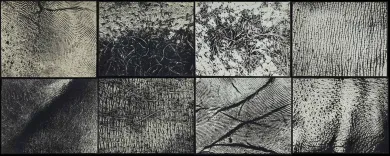
The (legal) person and the legal form. Chapter II
8, 12, 15 January, 2026 – 16:00 to 19:00
As part of the Studies Constellation, the Study Directoship’s annual fellowship, art historian and theorist Sven Lütticken leads the seminar The (Legal) Person and the Legal Form: Theoretical, Artistic, and Activist Commitments to foster dialogue and deepen the hypotheses and questions driving his research project.
This project, titled Unacting Personhood, Deforming Legal Abstraction, explores the dominance of real abstractions—such as exchange value and legal form—over our processes of subjectivation, and asks how artistic practices can open up alternative ways of representing or performing the subject and their legal condition in the contemporary world.
The seminar consists of eight sessions, divided into three chapters throughout the academic year. While conceived as non-public spaces for discussion and collective work, these sessions complement, nourish, and amplify the public program of the Studies Constellation.
In this second chapter of the seminar, the inquiry into the aesthetics and politics of legal form continues with three sessions that pick up the discussions held in Chapter I but propose new lines of flight. The first session focuses on international law via the writings of the British author China Miéville, which allows us to reconsider the notion of the legal form –following Evgeny Pashukanis— and, through it, a variety of (people’s) tribunals. While the crucial concept of the legal person –as the right-holder central to the form of law— was debated in Chapter I, the second session focuses on attempts to extend personhood not (just) to corporations, but rather to nonhuman animals or ecosystems. Finally, the third session poses the question: how can groups and networks use officially recognized organizational forms (such as the foundation or the cooperative) and/or use a collective persona (without necessarily a legal “infrastructure” to match) to act and represent themselves?

Oliver Laxe. HU/هُوَ. Dance as if no one were watching you
Tuesday, 16 December 2025 – 7pm
As a preamble to the opening of the exhibition HU/هُوَ. Dance as if no one were watching you, film-maker Oliver Laxe (Paris, 1982) engages in conversation with the show’s curators, Julia Morandeira and Chema González, touching on the working processes and visual references that articulate this site-specific project for the Museo Reina Sofía. The installation unveils a new programme in Space 1, devoted from this point on to projects by artists and film-makers who conduct investigations into the moving image, sound and other mediums in their exhibition forms.
Oliver Laxe’s film-making is situated in a resilient, cross-border territory, where the material and the political live side by side. In HU/هُوَ. Dance as if no one were watching you, this drift is sculpted into a search for the transcendency that arises between dancing bodies, sacred architectures and landscapes subjected to elemental and cosmological forces. As a result, this conversation seeks to explore the relationship the piece bears to the imagery of ancient monotheisms, the resonance of Persian Sufi literature and the role of abstraction as a resistance to literal meaning, as well as looking to analyse the possibilities of the image and the role of music — made here in collaboration with musician David Letellier, who also works under the pseudonym Kangding Ray — in this project.
These inaugural conversations, part of the main working strands of the Museo’s Public Programmes Area, aim to explore in greater depth the exhibition narratives of the shows organised by the Museo from the perspective of artists, curators and specialists.
Manuel Correa. The Shape of Now
13 DIC 2025
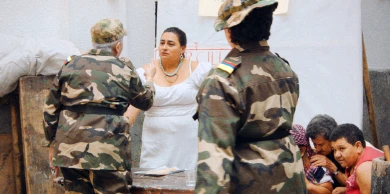
The Shape of Now is a documentary that explores the challenges and paradoxes of memory, reparation and post-conflict justice, extending a defiant and questioning gaze towards the six-decade armed conflict in which the Colombian State, guerrillas and paramilitary groups clashed to leave millions of victims in the country. The screening is conducted by the Aesthetics of Peace and Desertion Tactics study group and includes a presentation by and discussion with the film’s director, Manuel Correa.
The film surveys the consequences of the peace agreements signed in 2016 between the Colombian State and the FARC guerrilla organisation through the optics of different victims. It was recorded shortly after this signing, a time in which doubts lingered over the country’s future, with many groups speculating in the narration. Correa harnesses the power of images, visual and bodily memory, fiction and re-staging as tools for understanding the conflict, memory and healing, as well as for the achievement of a just peace that acknowledges and remembers all victims.
The activity is framed inside the research propelled by Aesthetics of Peace and Desertion Tactics, a study group developed by the Museo’s Study Directorship and Study Centre. This annual group seeks to rethink, from a theoretical-critical and historical-artistic perspective, the complex framework of concepts and exercises which operate under the notion of pacifism. A term that calls on not only myriad practices ranging from anti-militarism and anti-war movements to activism for non-violence, but also opens topical debates around violence, justice, reparation and desertion.
Framed in this context, the screening seeks to reflect on propositions of transitional and anti-punitive justice, and on an overlapping with artistic and audiovisual practices, particularly in conflicts that have engendered serious human rights violations. In such conflicts, the role played by audiovisual productions encompasses numerous challenges and ethical, aesthetic and political debates, among them those related to the limits of representation, the issue of revictimisation and the risks involved in the artistic commitment to justice. These themes will be addressed in a discussion held after the session.
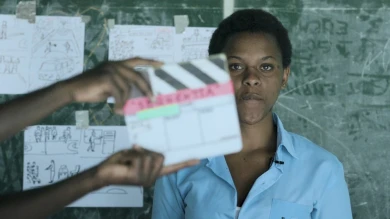
Christian Nyampeta and the École du soir
12 DIC 2025
This second instalment of Cinema Commons, a research, programming and publishing project which explores how film articulates interpretive communities, fosters collective debate and devises proposals for common space, comprises three sessions with Rwandan artist, musician and film-maker Christian Nyampeta and Ècole du soir. The programme’s first session screens video works made by Nyampeta, while the second sets forth a dialogue on the creative processes of Ècole du soir. The third brings proceedings to a close with the screening of a film selected by the artist: Ousmane Sembène’s Guelwaar (1992).
The work of Christian Nyampeta encompasses pedagogies and community forms of knowledge production and transmission. His Ècole du soir (Evening School) is an art project conceived as a mobile space of collective learning and is named in homage to Ousmane Sembène (1923–2007), a pioneer of African cinema who defined his films as “evening classes” for the people, a medium of education and emancipation through culture.
The New York-based artist from Rwanda uses art and museums to create spaces of encounter and common learning that predate colonial education models. Via popular culture frames of reference like comics, music and film, Nyampeta develops dynamics and spaces from which to build experiences which redress the wounds of diaspora and its consequences; further, his work recovers, makes visible and heals — through a pedagogical and artistic process — the social divides of the African people. With Ècole du soir he also works on creations without authorship and uses the counter-ethnographic legacy of novelist and film-maker Ousmane Sembène as a tool to deconstruct the Western view of Africa.