
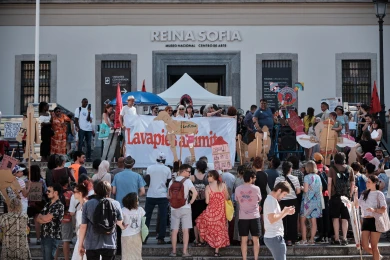
Miralda and Benet Rossell, París. La Cumparsita, 1972
Museo Reina Sofía
Held on 08 Oct 2025; 24 Jun 2026
The study group Aesthetics of Peace and Tactics of Desertion: Prefiguring New Pacifisms and Forms of Transitional Justice proposes a rethinking—through both a theoretical-critical and historical-artistic lens—of the intricate network of concepts and practices operating under the notion of pacifism. A term not without contestation and critical tension, pacifism gathers under its name a multiplicity of practices—from anti-militarism and anti-war movements to non-violence activism—while simultaneously opening urgent debates around violence, justice, reparation, and desertion. Here, pacifism is not conceived as a moral doctrine, but as an active form of ethical and political resistance capable of generating aesthetic languages and new positions of social imagination.
Through collective study, the group seeks to update critical debates surrounding the use of violence and non-violence, as well as to explore the conflict of their representation at the core of visual cultures. In a present marked by rearmament, war, genocide, and the collapse of the social contract, this group aims to equip itself with tools to, on one hand, map genealogies and aesthetics of peace—within and beyond the Spanish context—and, on the other, analyze strategies of pacification that have served to neutralize the critical power of peace struggles. Transitional and anti-punitive justice proposals will also be addressed, alongside their intersections with artistic, visual, and cinematic practices. This includes examining historical examples of tribunals and paralegal activisms initiated by artists, and projects where gestures, imaginaries, and vocabularies tied to justice, reparation, memory, and mourning are developed.
It is also crucial to note that the study programme is grounded in ongoing reflection around tactics and concepts drawn, among others, from contemporary and radical Black thought—such as flight, exodus, abolitionism, desertion, and refusal. In other words, strategies and ideas that articulate ways of withdrawing from the mandates of institutions or violent paradigms that must be abandoned or dismantled. From feminist, internationalist, and decolonial perspectives, these concepts have nourished cultural coalitions and positions whose recovery today is urgent in order to prefigure a new pacifism: generative, transformative, and radical.
Aesthetics of Peace and Tactics of Desertion, developed and led by the Museo Reina Sofía’s Studies Management, unfolds through biweekly sessions from October to June. These sessions alternate between theoretical discussions, screenings, work with artworks and archival materials from the Museo’s Collection, reading workshops, and public sessions. The group is structured around sustained methodologies of study, close reading, and collective discussion of thinkers such as Judith Butler, Elsa Dorlin, Juan Albarrán, Rita Segato, Sven Lütticken, Ruth Wilson Gilmore, and Franco “Bifo” Berardi; historical episodes such as the anti-nuclear and anti-arms race movement in Spain; and the work of artists and activists including Rojava Film Commune, Manuel Correa and the Oficina de Investigación Documental (Office for Documentary Investigation), and Jonas Staal, among other initial cases that will expand as the group progresses.
Directed by
Julia Morandeira Arrizabalaga and Lola Visglerio Gómez
Coordinated by
Elena Corrales Pérez and Ana Vidal González
Organised by
Museo Reina Sofía
Participant Selection
Particular consideration will be given to candidates whose background and interests align with the study group's contents, as well as their commitment to regular attendance in the chosen format (on-site or online).
Participation requires a biweekly time commitment of two and a half hours per session, in addition to preparation time.
Agenda
miércoles 08 oct 2025 a las 17:30
Session 1. Introduction to the study group. Rethinking pacifism today: the discomfort of peace
miércoles 22 oct 2025 a las 17:30
Session 2. Uses of (non)violence: self-defense, subjectivation and resistance
— Cross-reading of Elsa Dorlin and Judith Butler
Work readings:
- Butler, J. (2020). Introduction. In The Force of Nonviolence: An Ethico-Political Bind (pp. 11-26). Verso.
- Dorlin, E. (2022). Introduction (What a Body Can Do) and Chapter 1 (The Manufacture of Defenseless Bodies). In Self-Defense: A Philosophy of Violence (pp. 1-26). Verso.
Complementary materials:
- Butler, J. (2009). Survivability, Vulnerability, Affect (Chapter 1). In Frames of War: When Is Life Grievable? (pp. 33-62). Verso.
miércoles 05 nov 2025 a las 17:30
Session 3. Aesthetics of violence and the conflict of representation I
—On the representation of victims of violence(s) in the Basque Country: three photographic projects, with Juan Albarrán
Work readings:
- Portela, E. (2016). El eco de los disparos: cultura y memoria de la violencia (pp. 119–146). Galaxia Gutenberg.
Complementary materials:
- Albarrán Diego, J. (2021). Susan Sontag, ante la representación de la tortura. Aisthesis. Revista Chilena de Investigaciones Estéticas, (69), 281–297.
- González de Durana, J. (Ed.). (2004). Laocoonte devorado. Arte y violencia política. Artium; Centro José Guerrero; DA2.
- Guerra, C. (Ed.). (2018). La paz aplazada. Documentos y ensayos en torno a una exposición. Fundació Tàpies.
- Sánchez Biosca, V. (2017). Miradas criminales, ojos de víctima. Imágenes de la aflicción en Camboya. Prometeo.
miércoles 19 nov 2025 a las 17:30
Session 4. Aesthetics of violence and the conflict of representation II
—Cross-reading of Ariella Azoulay, Ariel Goldberg and Yazan Khalili
Work readings:
- Azoulay, A. A. (2008). Whose Gaze? In The Civil Contract of Photography (pp. 375–411). Zone Books.
- Goldberg, A., & Khalili, Y. (2021, February). We Stopped Taking Photos. e-flux Journal, (115).
Complementary materials:
- Azoulay, A. A. (2008). Introduction. In The Civil Contract of Photography (pp. 9–30). Zone Books.
miércoles 03 dic 2025 a las 17:30
Session 5. Transitional justice: artistic interventions and reparative futures I
—Archiviolítica. Methods and exoduses, with Andrés Jurado
Work readings:
- Bermúdez, E. (2020). La música colombiana, pasado y presente. In A. Recasens & C. Spencer (Eds.), A tres bandas: Mestizaje, sincretismo e hibridación en el espacio sonoro iberoamericano (pp. 247–255). SEACEX; AKAL.
- Cure, S., & Jurado, A. (2022). CORTES, Cortacabezas: Conversaciones fragmentadas y visionarias sobre predación y tecnocapitalismo en la Amazonia colombiana. Revista Anthropológicas, 33(2), 114–132. https://doi.org/10.51359/2525-5223.2022.257002
- Figueroa-Salamanca, H. H., Carreño-Gómez, P. J., & Rey-Rodríguez, A. F. (2021). Los orígenes del pacifismo en la ATCC. En defensa del desarrollo territorial y la paz en Colombia (1987–1990). Eleuthera, 23(2), 207–232.
- Flórez Arias, J. M. (2025). Los árboles que borran la sabana: la colonización "verde" del Vichada. Mutante.
- Iyokina Gittoma, V. (2024). Tarro vacío [Short film]. La Vulcanizadora.
- Jurado, A. (2020). El renacer del Carare/The Rebirth of Carare [Short film]. La Vulcanizadora.
- Jurado, A. (2022). Yarokamena [Short film]. La Vulcanizadora.
- Rojas Arias, M. (2021). Abrir monte [Short film]. La Vulcanizadora.
- Rojas Arias, M. (2023). Un lugar para pensar tropicalmente (Bienal das Amazônias) [A Place to Think Tropically (Amazônias Biennial)] [Short film].
- Guzmán, G., Fals Borda, O., & Umaña Luna, E. (1962). La Violencia en Colombia. Tercer Mundo.
- Sánchez, G. (1985). Los Bolcheviques del Líbano Tolima. El Áncora Editores.
- Viveiros de Castro, E. (2018). Los involuntarios de la patria. Le Partage. https://www.partage-le.com/2018/09/09/los-involuntarios-de-la-patria-eduardo-viveiros-de-castro/
- La Vulcanizadora. (2025). La impureza del documental. Cuadernos de Cine Colombiano, (35), 106–135.
miércoles 17 dic 2025 a las 17:30
Session 6. Transitional justice: artistic interventions and reparative futures II
—With Manuel Correa
Work readings:
- Giraldo, M., & Restrepo, C. (Dirs.). (2018). The Shape of Now [Feature film]. Atelier Bolombolo.
- Rieff, D., & De Greiff, P. (2016). Does Collective Remembrance of a Troubled Past Impede Reconciliation? [Online debate].
Complementary materials:
- Collins, C. (2018). Transitional Justice "From Within": Police, Forensic and Legal Actors Searching for Chile's Disappeared. Journal of Human Rights Practice, 10 (3), 395–414.
- Correa, M., & Forensic Architecture. (2022). Situated Testimonies [Video].
- Feldman, A. (2015). Chapter 1 (Before the Law at Guantánamo). In Archives of the Insensible: Of War, Photopolitics, and Dead Memory (pp. 33–68). The University of Chicago Press.
- Feldman, A. (2019). War Under Erasure: Contretemps, Disappearance, Anthropophagy, Survivance. Theory & Event, 22(1), 175–203.
lunes 28 sep 2026 a las 17:30
Session 7. Introduction to the second term: Narratives and visual cultures of peace
—Research presentations by group members: Head Shaving: Archives and Repertoires of Shame, with Ana Pol
Work readings:
- Azoulay, A. A. (2019). Natural History of Rape (T. Badia, Trans.). Fundació Antoni Tàpies.
- Ministry of the Presidency, Relations with Parliament and Democratic Memory. (2023). Las rapadas: El rapado de cabello de las mujeres como forma de violencia y humillación política durante la guerra y la dictadura [Teaching guide]. Government of Spain.
- Périot, J.-G. (2006). Eût-elle été criminelle... [Short film].
- Pol, A. & Rosón, M. (2024). Head Shaving: Archives and Repertoires of Shame. Journal of Women's History, 36(4), 151-172.
miércoles 11 feb 2026 a las 17:30
Session 8. Imaginaries and strategies of peace, solidarity and internationalism I
—Who Is Afraid of the Bandung Spirit?, with Philippe Pirotte
Work readings:
- Mey, V., & Pirotte, P. (2025). Who's Afraid of the Bandung Spirit? In V. Mey & P. Pirotte (Eds.), Who's Afraid of the Bandung Spirit? (pp. 1–20). Unpublished manuscript.
Complementary materials:
- Chakrabarty, D. (2010). The Legacies of Bandung: Decolonization and the Politics of Culture. In Making a World after Empire: The Bandung Moment and Its Political Afterlives (pp. 45–68). Ohio University Press.
- Finder, D. M. (2020). Blinded by Bandung? Illumining West Papua, Senegal, and the Black Pacific. Comparative Studies of South Asia, Africa and the Middle East, 40(1), 164–182.
- Gupta, A. (2016). After Bandung: Transacting the Nation in a Postcolonial World. In Postwar: Art between the Pacific and Atlantic, 1945–1965 (pp. 632–637). Haus der Kunst; Prestel.
- Prashad, V. (2007). The Darker Nations: A People's History of the Third World. The New Press.
- Samour, N. (2025). Palestine at Bandung: The Longwinded Start of a Reimagined International Law. In V. Mey & P. Pirotte (Eds.), Who's Afraid of the Bandung Spirit? (pp. 1–21). Spector Books.
- Shimazu, N. (2014). Diplomacy as Theatre: Staging the Bandung Conference of 1955. Modern Asian Studies, 48(1), 225–252.
miércoles 25 feb 2026 a las 17:30
Session 9. Imaginaries and strategies of peace, solidarity and internationalism II
—Research presentations by group members: Images of peace? Aesthetics and strategies of peace and internationalism in the Spanish Anti-NATO Movement, with Giulia Quaggio and Lola Visglerio Gómez
Work readings:
- Quaggio, G. (2025). The Dark Mirror of Latin America and the Spanish Anti-NATO Movements in the Late Cold War. In L. A. Brunet & E. Karamouzi (Eds.), Beyond the Euromissile Crisis: Global Histories of Anti-Nuclear Activism in the Cold War (pp. 253–278). Berghahn Books.
Complementary materials:
- Quaggio, G. (2021). Walls of Anxiety: The Iconography of Anti-NATO Protests in Spain, 1981–1986. Journal of Contemporary History, 56(3), 693–719.
- Quaggio, G., & Molina, S. (Eds.). (2023). Imaginando la Guerra Fría desde los márgenes. Comares.
- VV. AA. (2018). The Long 1980s: Constellations of Art, Politics and Identities. Valiz; L'Internationale.
- Ziemann, B. (2008). The Code of Protest: Images of Peace in the West German Peace Movements, 1945–1990. Contemporary European History, 17(2), 237–261.
miércoles 11 mar 2026 a las 17:30
Session 10. Imaginaries and strategies of peace, solidarity and internationalism III
—Past Disquiet: Excavating Solidarity in the Arts, with Rasha Salti
Work readings:
- Khouri, K., & Salti, R. (Eds.). (2018). Past Disquiet: Essays on the International Art Exhibition for Palestine and 1970s Anti-Imperialist Solidarity (pp. 27–59). Museum of Modern Art in Warsaw.
Complementary materials:
- Museu d'Art Contemporani de Barcelona. (2015). Past Disquiet. Narratives and Ghosts from the International Art Exhibition for Palestine, 1978.
miércoles 25 mar 2026 a las 17:30
Session 11. Feminisms and raging peace
—Research presentations by group members: Photography as feminist insurrection: visual practices of a raginge peace, with Sandra Bustamante; Feminist memories in Latin America, with Sandra Villanueva-Gallardo.
Work readings:
- Cvetkovich, A. (2003). Introduction. In An Archive of Feelings: Trauma, Sexuality, and Lesbian Public Cultures (pp. 1–7). Duke University Press.
- Villanueva-Gallardo, S. (2025). Outsider-insider: una experiencia identitaria de los feminismos latinoamericanos. Íconos. Revista de Ciencias Sociales, 29(81), 199–216.
Complementary materials:
- Cixous, H. (1992). Introduction. In D. Jenson (Ed.), Coming to Writing and Other Essays (pp. 1–58). Harvard University Press.
- Cixous, H. (Summer, 1976). La Laugh of the Medusa. Signs, 1(4), pp. 875-893.
- De La Cerda, D. (2023). Feminismo sin cuarto propio. IEn Desde los zulos (pp. 11–46). Sexto Piso.
- Mora, M. (2022). Agendas feministas anti-racistas y descoloniales, la búsqueda del locus de enunciación del ser mestiza. Estudios Sociológicos, 40 (Special Issue), 179–210.
miércoles 08 abr 2026 a las 17:30
Session 12. Desertion: fugitive aesthetics and tactics I
— Desertion, Escape, Strike: Rejection and Non-Reconciliation, with Julia Morandeira Arrizabalaga
- Berardi, F. (2024). Introduction. In Quit Everything: Interpreting Depression. Repeater Books.
miércoles 22 abr 2026 a las 17:30
Session 13. Desertion: fugitive aesthetics and tactics II
— The Desire to Stop a War: Liberation Radio, with Martí Manen
- Johnson, E., Nguyen, N., & Sweet, M. (2025). Liberation Radio fine cut [Video]. Index Foundation.
- The Swedish Contemporary Art Foundation. (2025). Liberation Radio [Exhibition handout]. (2025). Index Foundation. https://indexfoundation.se/media/lr_exhibition_handout.pdf
- Sweet, M. (Host). (2026, February 2). Liberation Radio [Audio podcast episode]. In The Documentary Podcast. BBC World Service. https://www.bbc.co.uk/programmes/p0mxpj6g
miércoles 06 may 2026 a las 17:30
Session 14. Carceral and abolitionist geographies
—Cross-reading of Ruth Wilson Gilmore and Fred Moten
Work readings:
- Gilmore, R. W. (2022). Abolition Geography and the Problem of Innocence. In B. Bhandar & A. Toscano (Eds.), Abolition Geography: Essays Towards Liberation (pp. 373–394). Verso.
- Gilmore, R. W. (2025, May 25). Abolir la industria del castigo: retos y prácticas políticas para la emancipación [Video]. Institut Català Internacional per la Pau.
- Moten, F. (2023). The Abolition of Art, the Abolition of Freedom, the Abolition of You and Me. Wave Books.
Complementary materials:
- Gilmore, R. W. (2025, May 26). Seguridad y justicia: modelos alternativos al punitivismo [Video]. Institut Català Internacional per la Pau. https://www.youtube.com/live/KN97LghMyMM?si=D9tl1gdXKkPMolXG
miércoles 20 may 2026 a las 17:30
Session 15. Anti-Punitivism and transformative justice
— Screening and discussion of Oído odio, by Diego del Pozo Barriuso
Work readings:
- Del Pozo Barriuso, D. (Dir.). (2021). Oído odio [Feature film].
- Barnard Center for Research on Women. (2020, March 11). What is Transformative Justice? [Video]. https://bcrw.barnard.edu/videos/what-is-transformative-justice/
miércoles 03 jun 2026 a las 17:30
Session 16. What idea of peace today?
— Closing session

![Francesc Abad, Procés transformació [Proceso transformación, 1972]. Museo Reina Sofía](https://recursos.museoreinasofia.es/styles/small_landscape/public/Actividades/AD05219-009-actividad.jpg.webp)
![Basel Abbas y Ruanne Abou-Rahme, At Those Terrifying Frontiers Where the Existence and Disappearance of People Fade Into Each Other [En esas fronteras aterradoras donde la existencia y la desaparición de personas se disuelven entre sí], 2019](https://recursos.museoreinasofia.es/styles/small_landscape/public/Colecci%C3%B3n/abbasabourahme.png.webp)
Más actividades
![Isabel Coixet, 100 Years and You Everywhere [100 años y tú en todos los sitios], 2026, película](https://recursos.museoreinasofia.es/styles/small_landscape/public/Actividades/2.diseminar-mundo.jpg.webp)
John Berger and Isabel Coixet. Continued Ways of Seeing
Thursday, 17 September 2026 at 7pm
Ways of Seeing (1972) is one of the most revolutionary television series on art history, the museum and contemporary critical culture. Across four episodes, an articulate, enthusiastic John Berger unpacks the relationships between classical art through the gaze and new technology, the nude and feminism, the oil painting and commodity fetichism, advertising and consumerism. In essence, a level of critical commitment only comparable to its capacity for dissemination. Unsurprisingly, the series, and the book that would distil it, continues to forge vocations. This session sees art historians Alberto López Cuenca and Modesta Di Paola carry out an analysis of Berger’s audiovisual work, placing the stress on episodes one and four of the series. In the first episode, Berger reflects on the connection between the act of seeing, looking and being in light of new technology, such as the film camera. At the same time, it analyses how the culture of reproduction is turning paintings into messages or fragments of communication while stressing the importance of silence when observing historical paintings. In the fourth and final episode, he introduces advertising as a new iconic-verbal language that shares certain principles with the message of oil painting as a luxury item.
The session opens with the premiere of a filmic letter from Isabel Coixet, one of Spain’s most internationally acclaimed directors, to John Berger, with whom she maintained a long friendship and deep admiration. The short film is testament to the ubiquitous and long-lasting presence of the author of Ways of Seeing, even after his death in 2017.
![Chantal Akerman, Woman Sitting after Killing [Mujer sentada después de matar], 2001, instalación. Museo Reina Sofía](https://recursos.museoreinasofia.es/styles/small_landscape/public/Actividades/chantal-akerman-mujer-sentada-despues-matar.jpg.webp)
On Your Screen: Art History and the Museum Facing the Audiovisual Challenge
18, 19 SEP 2026
The conference On Your Screen: Art History and the Museum Facing the Audiovisual Challenge sparks debate around the transformations of art history and museum space upon embracing the audiovisual format. Its starting point is John Berger’s emblematic television series Ways of Seeing (1972), a landmark in the democratisation of art-historical discourse. In the series, Berger illustrated how the transfer of a work such as Goya’s Los fusilamientos del 3 de mayo (The Third of May 1808 or the Executions) from museum gallery to home TV screen completely changed the viewer’s experience, allowing the image to travel to straight to the viewer.
In the twenty-first century, this screen-based ecosystem has expanded exponentially, with museums not only physically integrating screenings and devices into their galleries— following in the wake of many exhibitions on the moving image — but also deploying complex virtual strategies. Equally, numerous en vez de a multitudeof historians, students and creators use digital platforms to circulate their ideas and projects. This audiovisual shift opens access to ignored materials and democratises knowledge, as well as challenging traditional hierarchies and the interpretive authority of institutions. The conference, promoted by the research project ATLAS AV: The Audiovisualisation of Art History and the Museum, seeks to analyse this vast audiovisual material, its archives, and its capacity to transform the memory of art.
Godard and Miéville: Time and Ruin
Friday, 18 September 2026 - 7pm
Inside the framework of the conference On Your Screen: Art History and the Museum Facing the Audiovisual Challenge, this film series sets forth three critical visions of the museum via three sessions featuring the works of John Berger, Jean-Luc Godard and Anne-Marie Miéville, Ariella Azoulay, Alan Resnais and Chris Marker, Kwate Nee-Owoo, and the premiere of short films by Isabel Coixet and La Vulcanizadora (Maria Rojas Arias and Andrés Jurado). In classical theory, the museum gives the world meaning; it contains fragments of the past, granting them a history, a narrative that explains preterite time and the present. Today, there is an implicit assumption that this function hides and legitimises forms of power, yet what if the museum, instead of explaining the world, multiplied it through radical ideas, silenced periods and repressed subjects? Such is the approach of the film-makers and artists in this film season.
In 1972 the writer John Berger opened the landmark television series Ways of Seeing with an iconoclastic gesture: slicing Sandro Botticelli’s painting Venus and Mars (1485) in London’s National Gallery. A transgressive act that recalls contemporary attacks on the museum by dissident youth and with which Berger, after revealing it was a reproduction, sought to ignite debate around the idea of an original artwork and a copy. In this, the hundredth anniversary of his birth, the first session pays homage to one of the great art writers of the twentieth century. Starting with a review of Berger’s audiovisual work by art historians Alberto López Cuenca and Modesta Di Paola, the series begins with the premiere of 100 Years and You Everywhere (2026), an unreleased short film by Isabel Coixet composed as a beautifully crafted letter to Berger, and continues with an analysis of fragments of Ways of Seeing in relation to the museum and contemporary art.
The second session screens two medium-length films by Jean-Luc Godard and Anne-Marie Miéville on time, ruin and museum. In The Old Place. Small Notes Regarding the Arts at Fall of 20th Century (1999), both film-makers consider what remains of that “old place”, the museum, at the close of a century of wars and totalitarianism, and ask whether it should be more of a legend or desire than a place. This same driving principle leads Godard to build his own imaginary museum in Reportage amateur (maquette expo) (2006), a rickety toy museum which, paradoxically, contains the great film-maker’s full power of thought on history and images.
Finally, the third session explores one of the major challenges of recent years: the decolonisation of the museum, the recognition of its link to imperialist discourses of power and the need to situate a new silenced or repressed subject at the centre of the Western narration of history. Under the title Museums and Restitution, it includes the film Undocumented. Unlearning Imperial Plunder (2019), by theorist Ariella Azoulay, Statues Also Die, by Alan Resnais and Chris Marker (1953), Kwate Nee-Owoo’s You Hide Me (1970) and the first screening of the short film Quinto verso, parte de Tonada (Fifth Verse, Part of Tonada), by La Vulcanizadora (Maria Rojas Arias and Andrés Jurado), filmed at the Museo de América in Madrid.
![Ariella Azoulay, Un-documented. Unlearning Imperial Plunder [Indocumentados. Desaprendiendo el saqueo imperial], 2019, película](https://recursos.museoreinasofia.es/styles/small_landscape/public/Actividades/5.diseminar-mundo.jpg.webp)
Museums and Restitution
Saturday, 19 September 2026 - 7pm
Centuries of plundering, decades of amnesia, years of living with unmitigated extractivist power… Does a museum, as we know it, have a raison d'être in a postcolonial society?
This session expounds the operations of the museum as a colonial machine, while putting forward ideas, in narration, for a more just, equal and inclusive institution of the future via society’s marginalised and minority voices. The session begins with the international premiere of Quinto verso, parte de Tonada (Fifth Verse, Part of Tonada), which presents a vision of the Quimbaya Collection (fifth and sixth centuries CE) from the Museo de América in Madrid. It is constructed with the voices and chants of Wayúu mourners and guides, not only as a way of reinstating the role of these gold idols — anthropomorphic figures of men and women used as vessels in ritual practices — but also to imagine that what must be exhibited is not the gold itself. It is the ritual’s own chant. In the classic film You Hide Me (1970), Ghanaian film-maker Kwate Nee-Owoo accesses the British Museum’s collection of African art, located in the building’s basement, to question the meaning behind a museum plundering and nullifying. A fine exercise of first-person institutional critique screened for the first time in Spain. Almost seventy years since Resnais and Marker made Statues Also Die (1953), a reflection on the aura-bearing value of the museum opposite the identity-based and cultural belonging of African art, theorist Ariella Azoulay films the same statues again at the Musée du Trocadéro (today the Musée du Quai Branly), which survive and wait to be reunited with their people. Azoulay, whose wholly original undertaking is a lesson to the museum of the future, connects the forced migration of these sculptures with the mass transit of people crossing borders artificially imposed by the same system that has plundered their culture.
The School of Transformative Institutionalism and Local Organisation
From 21 to 24 September 2026
The School of Transformative Institutionalism and Local Organisation (S.T.I.L.O.) is a programme of joint learning and join strategy which sets in motion a process for the exchange of questions, methodologies and experiences between cultural organisations. The overall aim is to create, circulate and prototype tactics, tools and collective knowledge on institutional practices that open new channels for defending culture and advocating structural transformation in divergent geographical contexts.
The project is part of the Laboratorio de Institucionalidad Compartida (The Laboratory of Shared Institutionalism, LIC), a space for the Museo Reina Sofía’s research, work and advocacy centred on developing, experimenting with and systemising practices, protocols and tools which contribute to a fairer and more liveable cultural ecosystem.
For many years now, so-called infrastructural critique in museums questions material, legal and economic infrastructures, among others, as well as the forms of solidarity and practices required to sustain the cultural ecosystem. By approaching current debates, S.T.I.L.O. raises questions on the ways in which organisations define and interpret their practices, organise their relations and respond to the social contexts in which they operate.
The school gathers four cultural organisations that work via different institutional models – scale, contexts, conditions, different working models — with the goal of pooling common strategies and tools of organisation, advocacy and relationships with local communities.
The programme is conceived as a collaborative process with the participation of Arika, La Revuelta, BAK Basecamp and The Tentacular Museum (Museo Reina Sofía) and is structured around preparatory online sessions and an in-person seminar in Madrid.
S.T.I.L.O. is an activity framed inside the working strand of Situated Organisations from L'Internationale’s Museum of the Commons project, which reflects on the role of museums and art organisations as actors within complex social networks and ecosystems, with a view to exploring new ways to democratise institutions and make them more open, inclusive and useful.