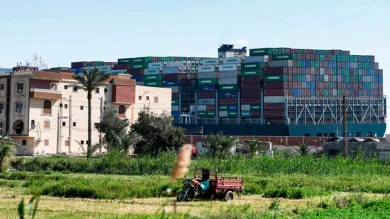
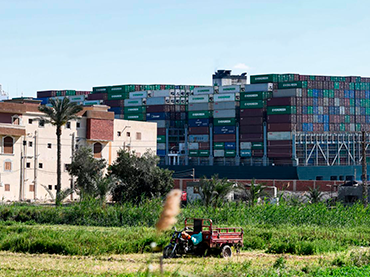
Trailer by the Ever Given ship jammed on the Suez Canal, Middle East Eye, 29 March 2021
Date and time
Held on 16 Sep 2017
Archipiélago is a concert series and research project that unfolded in the Museo Reina Sofía from 2017 to 2023 with the aim of questioning the universality of the term “experimentation” within the sphere of Western music. The term, which originated as a concept in the USA, has been replicated to the extent that it has created a canon and even a genre. Across its different editions, the series brought together different musicians, performers and researchers from around the world in an attempt to rethink other forms of experimentation beyond the frameworks of hegemonic thought. In collaboration with music groups and artists from different geographical areas, Archipelago approached this concept of “experimentation” from different perspectives.
Following a first edition in 2017, in which pioneering figures of minimalism encountered music and genres from non-European zones and new generations of artists, in 2018 it sought to resituate and question the term “experimental” with texts hailing from Central and South America and the Middle East, where the idea of experimentation as an avant-garde rupture lacks meaning opposite that of tradition as a living form of knowledge constantly mutating and spreading. Thus, in 2019 the programme introduced the act of listening to sound compositions and experimentations without applying any historical or geographical order, letting, by contrast, connections materialize between heterogenous languages and contexts. Despite the difficult circumstances brought about by COVID-19 in 2020 and 2021, a decision was made to back the physicality of live music and, therefore, strengthen local fabrics. In 2022, the project embarked upon a deep-time study of certain musical mutations that had not been addressed to an adequate degree from the previously investigated English-speaking narrative. Through a study of ocean currents, winds, trade routes and submarine cabling, a themed journey was put forward, one in which there is little to no difference between experimentation and tradition. Finally, for the closing edition in 2023, Archipelago set forth an account of fictional archaeology to re-consider the discourse of Western modernity by listening to an “impossible past” from which to imagine other futures for music.
Curators
Rubén Coll y José Luis Espejo
Organised by
Museo Reina Sofía
Sponsor

-
September 16, 23 and 30, 2017 Sabatini Building
Archipelago 2017
Concert series
This first edition of Archipelago was enveloped in drone music and minimalism, exploring its influences and unexpected offshoots. The programme included key figures of experimentalism such as the French composer Éliane Radigue and the New York-based Japanese sound artist Yoshi Wada — both linked to minimalism and Fluxus, respectively. These “pioneering” figures were also joined by younger artists who, despite sharing certain compositional roots with Eastern music, adopt different formal approaches. For this particular edition, the artists presented commissioned and unreleased works, with the exception of Éliane Radigue’s Trilogie de la mort (Trilogy of Death), performed in its entirety by Emmanuel Holterbach for the first time in Spain.
Participants: Severine Beata and Javi Álvarez, Emmanuel Holterbach, iNSANLAR, Agnès Pe, Damián Schwartz, and Yoshi and Tashi Wada

-
Friday 21 and Saturday 22 September, 2018 (check programme) / Sabatini Building, Vaults Gallery, Garden and Auditorium, and Real Conservatorio Superior de Música de Madrid, Manuel de Falla Auditorium
Archipelago 2018
Concert series
In its second edition, Archipelago reasserted its intention to present listening as a form of both knowledge and aesthetic pleasure. This edition saw Rubén Coll join the curatorial project, which set forth more comprehensive research into the feeling of exhaustion that can be perceived in the West’s experimental scene, whereby the relationship between formal rupture and progress often proves unconvincing. The participating artists questioned the universality of experimentation precisely as it had been expounded in some of Europe’s and the USA’s major cities, often looking to vindicate the non-Western roots of their music.
Participants: AMMAR 808, Clara de Asís, DJ LAG, Errorsmith, Cedrick Fermont, Hashigakari, Áine O’Dwyer, Janneke van der Putten, Nadah El Shazly, Tarawangsawelas & Rabih Beaini, Toukadime and TUTU.

-
From 18 to 21 September 2019 Museo Reina Sofía (Sabatini Building, Vaults Gallery, Auditorium, Nouvel Building Auditorium, 400 Hall and Palacio de Cristal); Iglesia de San Millán y San Cayetano; Municipal School of Music and Dance, Distrito Centro María Dolores Pradera
Archipelago 2019
Concert Series
The 2019 edition explored the concept of tradition: a term associated with conservatism and regression in the face of change, but with a meaning that implies the transfer of knowledge from one person to another, from one generation to the next. Thus, the programme featured not only artists that experiment with non-Western roots, but also shone a light on noise, singeli and dance music, genres which subvert any attempt at classification via traditional forms such as electroacoustic, gnawa and traditional Kurpie music, as well as music from the nearby Madrid mountain range and the Galician bagpipes.
Participants: Saba Alizadeh, Asmâa, Kolida Babo, Rashad Becker, Lea Bertucci, Chulapeiras, Hamzaoui and Bnat Timbouktou, Gaba, Nina García, Ipek Gorgun, Miguel Nava and Rafa Martín, Bamba Pana & Makaveli, Psicolabio, Síria, R. Vincenzo, Lechuga Zafiro and Żywizna (Raphael Rogiński + Genowefa Lenarcik).

-
Friday, 18 and Saturday, 19 September 2020 (check programme) Nouvel Building, Auditorium 400
Archipelago 2020
Concert series
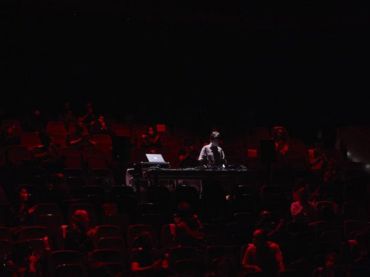
Organised at the height of the COVID-19 pandemic, this edition of Archipelago adopted an unusual format: all performances took place in the Nouvel Building’s Auditorium 400 with a quadrophonic arrangement of sound. Placing the stress on the physicality of sound and physical presence opposite streaming, DJ-led listening sessions were put forward and drew inspiration from the experience of diaspora, in addition to concerts that sought to reinvent the popular and speculate on what will come and be built in a highly unpredictable future.
Participants: Cher-ee-lee, Lucrecia Dalt and Jokkoo (Baba Sy & Mbodj), Jessica Ekomane and Tarta Relena.

-
December 2021 Nouvel Building, Auditorium 400, Lobby
Archipelago 2021
Concert Series
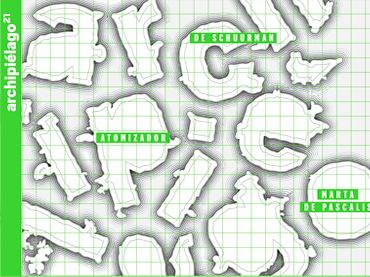
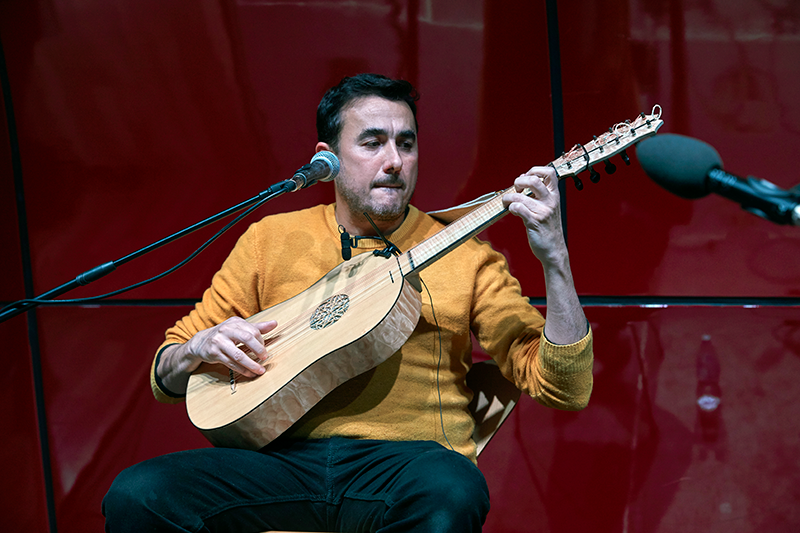
TicketsThis fifth edition tackled the complexity of the post-traumatic effects of lockdown and crisis, responding to this situation by focusing on the local scene, realised with Atomizador and his approach to psychodelia from the instrumentation that characterises historical Western music. Marta De Pascalis, a Berlin-based composer from Rome, explored the complex ramifications of contemporary electronic music through the filter of southern European tradition, while non-hegemonic rhythmic innovations — one of the festival’s core areas of interest — found a space in the session of De Schuurman, a key figure in the evolution of bubbling, a music genre originating from Afro-Dutch postcolonial diaspora and highly influential, despite its limited exposure.
Participants: Atomizador, Marta De Pascalis and De Schuurman
-
Saturday, 18 June 2022 Sabatini Building, Auditorium and Garden
Archipelago 2022
The Material Conditions of Our Music
TicketsStarting from the image of the ship Ever Given stranded on the Suez Canal in 2021, the sixth edition of Archipelago reflected on the material questions that influence music, for instance the transportation of raw materials and goods and the importance of ports, colonial routes and ocean currents, in addition to forced migrations. Through a string of concerts fusing traditional music and experimentation, Archipelago recapitulated, reinterpreted and overhauled learning related to the common history of traditional music to date.
Participants: Erkizia + Cantizano, Edna Martinez, Pujllay Masis, Mazaher and Mohammad Reza Mortazavi.
-
Friday, 16 and Saturday, 17 June 2023 Sabatini Building, Auditorium, southwest Stairwell and Garden
Archipelago 2023
El Hierro Will Once Again Be the Centre of the World
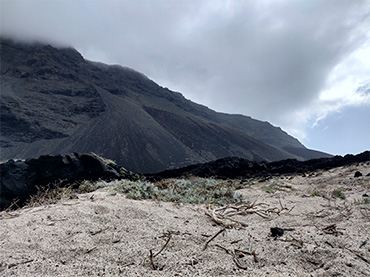
Tickets (16 June)The 2023 edition brought down the curtain on a theoretical and geopolitical journey through the musical mutations of our times which was set in motion in 2017 by José Luis Espejo and then jointly with Rubén Coll from 2018 onwards. The island of El Hierro, halfway between Africa, Europe and South America, is a metaphor for music that circumvents the Western media’s powerful grid, which in turn rules the taste, presence and even fees of musicians from the experimental scene. In this final edition, El Hierro will once again be the centre of the world.
Participants: The Folkloric Ensemble of Sabinosa, DJ Travella and DJ Diaki, Helena Girón and Samuel M. Delgado, and Tenores di Bitti "Mialinu Pira".
-
Multimedia
Archipelago 2017. Severine Beata and Javi Álvarez + iNSANLAR
Watch videoThis series of videos, made by Machines Desirantes Buro, documents the concerts performed in the first edition of Archipelago, in 2017, and is complemented with extensive interviews with the participants. This particular video features the concerts of Severine Beata and Javi Álvarez + iNSANLAR.
-
Multimedia
Archipelago 2017. Yoshi and Tashi Wada + Damián Schwartz
Watch videoThis series of videos, made by Machines Desirantes Buro, documents the concerts performed in the first edition of Archipelago, in 2017, and is complemented with extensive interviews with the participants. This particular video features the concerts of Yoshi and Tashi Wada + Damián Schwartz.
-
Multimedia
Archipelago 2017. Éliane Radigue by Emmanuel Holterbach + Agnès Pe
Watch videoThis series of videos, made by Machines Desirantes Buro, documents the concerts performed in the first edition of Archipelago, in 2017, and is complemented with extensive interviews with the participants. This particular video features the concerts of Emmanuel Holterbach and Agnès Pe.
-
Multimedia
Archipelago 2018
Watch videoThis video, made by Banda Negra, assembles the interventions from the second edition of Archipelago and includes interviews with some of its participants, exploring the possibility of new forms of listening from different twentieth-century sound recordings with a desire to unearth alternatives to the restraints of a canon built from now-exhausted genealogies and narratives.
-
Multimedia
Archipelago 2019
Watch videoThis video, made by Banda Negra, documents the third edition of Archipelago, exploring the concept of tradition: a term associated with conservatism and regression opposite change, but with a meaning that implies the transfer of knowledge, from one person to another, from one generation to the next.
-
Multimedia
Udlot, Udlot by José Maceda
Concert
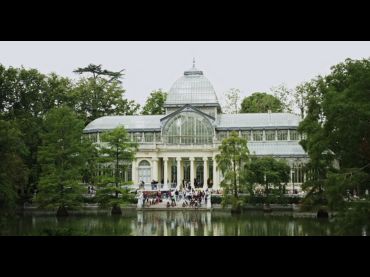
Watch videoThis video, made by Banda Negra, documents and contextualises the process of mediation, learning and performance of Udlot Udlot (1975), by Philippine composer José Maceda.
-
Multimedia
Archipelago 2022
The Material Conditions of Our Music
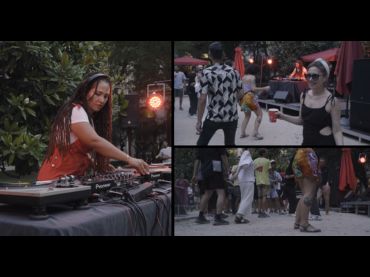
Watch videoThis video, made by Javi Álvarez and Irene de Andrés, reflects the narrative of the 2022 edition of Archipelago. The narration takes us through centuries-old colonial routes for the transportation of goods and cargo, routes which remain today and brought about cultural exchanges that impacted music.
-
Multimedia
Archipelago 2023
El Hierro Will Once Again Be the Centre of the World
Watch videoFrom 2018 onwards, the Archipelago concert series invited the audience to delve deeper into the complexity of the contemporary world through listening, seeking to foreground music genres and modes of listening which provide an alternative to European and US cultural centres. This video, made by Javi Alvárez and Irene de Andrés, documents the seventh, and final, instalment of Archipelago, which was centred on El Hierro, a volcanic island which was considered prime meridian for centuries. Located halfway between Africa, Europe and South America, the island is also a metaphor for all music that circumvents the Western media’s powerful grid.
This edition featured the screening of the film Eles transportan a morte (2021), by film-maker’s Helena Girón and Samuel M. Delgado, from Galicia and Tenerife, respectively; a performance by the Folkloric Ensemble of Sabinosa; music by DJ Travella from Tanzania and Malian DJ Diaki; and a concert by the Sardinian ensemble Tenores di Bitti “Mialinu Pira”.
-
Podcast
Archipelago 2020
How to Listen to Live Music Amid a Pandemic
Listen to podcastThis podcast, written and hosted by Rubén Coll and José Luis Espejo, presents the testimony of artists who participated in the 2020 edition of Archipelago, reflecting on how a cultural event is assembled by considering, for instance, the political and commercial structures that underpin our precarious music communities.
-
Pódcast
Archipelago 2021
Concert Series
Listen to podcastThe series shares, for the first time, the recordings of three concerts which comprised the 2021 edition.
Más actividades
![Isabel Coixet, 100 Years and You Everywhere [100 años y tú en todos los sitios], 2026, película](https://recursos.museoreinasofia.es/styles/small_landscape/public/Actividades/2.diseminar-mundo.jpg.webp)
John Berger and Isabel Coixet. Continued Ways of Seeing
Thursday, 17 September 2026 at 7pm
Ways of Seeing (1972) is one of the most revolutionary television series on art history, the museum and contemporary critical culture. Across four episodes, an articulate, enthusiastic John Berger unpacks the relationships between classical art through the gaze and new technology, the nude and feminism, the oil painting and commodity fetichism, advertising and consumerism. In essence, a level of critical commitment only comparable to its capacity for dissemination. Unsurprisingly, the series, and the book that would distil it, continues to forge vocations. This session sees art historians Alberto López Cuenca and Modesta Di Paola carry out an analysis of Berger’s audiovisual work, placing the stress on episodes one and four of the series. In the first episode, Berger reflects on the connection between the act of seeing, looking and being in light of new technology, such as the film camera. At the same time, it analyses how the culture of reproduction is turning paintings into messages or fragments of communication while stressing the importance of silence when observing historical paintings. In the fourth and final episode, he introduces advertising as a new iconic-verbal language that shares certain principles with the message of oil painting as a luxury item.
The session opens with the premiere of a filmic letter from Isabel Coixet, one of Spain’s most internationally acclaimed directors, to John Berger, with whom she maintained a long friendship and deep admiration. The short film is testament to the ubiquitous and long-lasting presence of the author of Ways of Seeing, even after his death in 2017.
![Chantal Akerman, Woman Sitting after Killing [Mujer sentada después de matar], 2001, instalación. Museo Reina Sofía](https://recursos.museoreinasofia.es/styles/small_landscape/public/Actividades/chantal-akerman-mujer-sentada-despues-matar.jpg.webp)
On Your Screen: Art History and the Museum Facing the Audiovisual Challenge
18, 19 SEP 2026
The conference On Your Screen: Art History and the Museum Facing the Audiovisual Challenge sparks debate around the transformations of art history and museum space upon embracing the audiovisual format. Its starting point is John Berger’s emblematic television series Ways of Seeing (1972), a landmark in the democratisation of art-historical discourse. In the series, Berger illustrated how the transfer of a work such as Goya’s Los fusilamientos del 3 de mayo (The Third of May 1808 or the Executions) from museum gallery to home TV screen completely changed the viewer’s experience, allowing the image to travel to straight to the viewer.
In the twenty-first century, this screen-based ecosystem has expanded exponentially, with museums not only physically integrating screenings and devices into their galleries— following in the wake of many exhibitions on the moving image — but also deploying complex virtual strategies. Equally, numerous en vez de a multitudeof historians, students and creators use digital platforms to circulate their ideas and projects. This audiovisual shift opens access to ignored materials and democratises knowledge, as well as challenging traditional hierarchies and the interpretive authority of institutions. The conference, promoted by the research project ATLAS AV: The Audiovisualisation of Art History and the Museum, seeks to analyse this vast audiovisual material, its archives, and its capacity to transform the memory of art.
Godard and Miéville: Time and Ruin
Friday, 18 September 2026 - 7pm
Inside the framework of the conference On Your Screen: Art History and the Museum Facing the Audiovisual Challenge, this film series sets forth three critical visions of the museum via three sessions featuring the works of John Berger, Jean-Luc Godard and Anne-Marie Miéville, Ariella Azoulay, Alan Resnais and Chris Marker, Kwate Nee-Owoo, and the premiere of short films by Isabel Coixet and La Vulcanizadora (Maria Rojas Arias and Andrés Jurado). In classical theory, the museum gives the world meaning; it contains fragments of the past, granting them a history, a narrative that explains preterite time and the present. Today, there is an implicit assumption that this function hides and legitimises forms of power, yet what if the museum, instead of explaining the world, multiplied it through radical ideas, silenced periods and repressed subjects? Such is the approach of the film-makers and artists in this film season.
In 1972 the writer John Berger opened the landmark television series Ways of Seeing with an iconoclastic gesture: slicing Sandro Botticelli’s painting Venus and Mars (1485) in London’s National Gallery. A transgressive act that recalls contemporary attacks on the museum by dissident youth and with which Berger, after revealing it was a reproduction, sought to ignite debate around the idea of an original artwork and a copy. In this, the hundredth anniversary of his birth, the first session pays homage to one of the great art writers of the twentieth century. Starting with a review of Berger’s audiovisual work by art historians Alberto López Cuenca and Modesta Di Paola, the series begins with the premiere of 100 Years and You Everywhere (2026), an unreleased short film by Isabel Coixet composed as a beautifully crafted letter to Berger, and continues with an analysis of fragments of Ways of Seeing in relation to the museum and contemporary art.
The second session screens two medium-length films by Jean-Luc Godard and Anne-Marie Miéville on time, ruin and museum. In The Old Place. Small Notes Regarding the Arts at Fall of 20th Century (1999), both film-makers consider what remains of that “old place”, the museum, at the close of a century of wars and totalitarianism, and ask whether it should be more of a legend or desire than a place. This same driving principle leads Godard to build his own imaginary museum in Reportage amateur (maquette expo) (2006), a rickety toy museum which, paradoxically, contains the great film-maker’s full power of thought on history and images.
Finally, the third session explores one of the major challenges of recent years: the decolonisation of the museum, the recognition of its link to imperialist discourses of power and the need to situate a new silenced or repressed subject at the centre of the Western narration of history. Under the title Museums and Restitution, it includes the film Undocumented. Unlearning Imperial Plunder (2019), by theorist Ariella Azoulay, Statues Also Die, by Alan Resnais and Chris Marker (1953), Kwate Nee-Owoo’s You Hide Me (1970) and the first screening of the short film Quinto verso, parte de Tonada (Fifth Verse, Part of Tonada), by La Vulcanizadora (Maria Rojas Arias and Andrés Jurado), filmed at the Museo de América in Madrid.
![Ariella Azoulay, Un-documented. Unlearning Imperial Plunder [Indocumentados. Desaprendiendo el saqueo imperial], 2019, película](https://recursos.museoreinasofia.es/styles/small_landscape/public/Actividades/5.diseminar-mundo.jpg.webp)
Museums and Restitution
Saturday, 19 September 2026 - 7pm
Centuries of plundering, decades of amnesia, years of living with unmitigated extractivist power… Does a museum, as we know it, have a raison d'être in a postcolonial society?
This session expounds the operations of the museum as a colonial machine, while putting forward ideas, in narration, for a more just, equal and inclusive institution of the future via society’s marginalised and minority voices. The session begins with the international premiere of Quinto verso, parte de Tonada (Fifth Verse, Part of Tonada), which presents a vision of the Quimbaya Collection (fifth and sixth centuries CE) from the Museo de América in Madrid. It is constructed with the voices and chants of Wayúu mourners and guides, not only as a way of reinstating the role of these gold idols — anthropomorphic figures of men and women used as vessels in ritual practices — but also to imagine that what must be exhibited is not the gold itself. It is the ritual’s own chant. In the classic film You Hide Me (1970), Ghanaian film-maker Kwate Nee-Owoo accesses the British Museum’s collection of African art, located in the building’s basement, to question the meaning behind a museum plundering and nullifying. A fine exercise of first-person institutional critique screened for the first time in Spain. Almost seventy years since Resnais and Marker made Statues Also Die (1953), a reflection on the aura-bearing value of the museum opposite the identity-based and cultural belonging of African art, theorist Ariella Azoulay films the same statues again at the Musée du Trocadéro (today the Musée du Quai Branly), which survive and wait to be reunited with their people. Azoulay, whose wholly original undertaking is a lesson to the museum of the future, connects the forced migration of these sculptures with the mass transit of people crossing borders artificially imposed by the same system that has plundered their culture.
The School of Transformative Institutionalism and Local Organisation
From 21 to 24 September 2026
The School of Transformative Institutionalism and Local Organisation (S.T.I.L.O.) is a programme of joint learning and join strategy which sets in motion a process for the exchange of questions, methodologies and experiences between cultural organisations. The overall aim is to create, circulate and prototype tactics, tools and collective knowledge on institutional practices that open new channels for defending culture and advocating structural transformation in divergent geographical contexts.
The project is part of the Laboratorio de Institucionalidad Compartida (The Laboratory of Shared Institutionalism, LIC), a space for the Museo Reina Sofía’s research, work and advocacy centred on developing, experimenting with and systemising practices, protocols and tools which contribute to a fairer and more liveable cultural ecosystem.
For many years now, so-called infrastructural critique in museums questions material, legal and economic infrastructures, among others, as well as the forms of solidarity and practices required to sustain the cultural ecosystem. By approaching current debates, S.T.I.L.O. raises questions on the ways in which organisations define and interpret their practices, organise their relations and respond to the social contexts in which they operate.
The school gathers four cultural organisations that work via different institutional models – scale, contexts, conditions, different working models — with the goal of pooling common strategies and tools of organisation, advocacy and relationships with local communities.
The programme is conceived as a collaborative process with the participation of Arika, La Revuelta, BAK Basecamp and The Tentacular Museum (Museo Reina Sofía) and is structured around preparatory online sessions and an in-person seminar in Madrid.
S.T.I.L.O. is an activity framed inside the working strand of Situated Organisations from L'Internationale’s Museum of the Commons project, which reflects on the role of museums and art organisations as actors within complex social networks and ecosystems, with a view to exploring new ways to democratise institutions and make them more open, inclusive and useful.