Trance Landscapes. The Films of Oliver Laxe
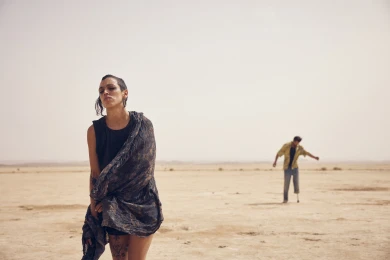
Oliver Laxe, Sirāt, 2025, film
Held on 05, 06, 07, 12, 13, 13, 14, 19, 20, 21, 26, 27, 28 Feb 2026
Over this coming month of February, the Museo organises a complete retrospective on the filmography of Oliver Laxe. The series converses with the work HU/هُوَ. Dance as if no one were watching you, an installation by the Sirāt director conceived specifically for the Museo Reina Sofía’s Espacio 1, and includes the four feature-length films Laxe has made to date, as well as his short films and a four-session carte blanche programme, in which he will select works that chime with his films and creative concerns.
Oliver Laxe’s gaze is one of the most unique in the contemporary film landscape, his film-making a resilient, spiritual and transcultural space imbued with a cultural and social nomadism that reflects his life and beliefs and which, fundamentally, puts forward an anti-materialist ethic to deal with our times. His filmography, characterised by profound spirituality, a time of contemplation and a close connection to nature and the sacred, approaches universal themes such as redemption and the meaning of existence via stories that extend across remote, rural and timeless landscapes, and with atmospheres that draw on western and police film genres. His protagonists, largely non-actors, cross through physical territories while travelling on inner journeys consumed by guilt, the desire for community reintegration and the realisation of an end goal they ignore. Nature, particularly desert and landscape, is another character, a living, pantheistic presence that conditions and reflects human conflicts. Stretched-out time, a focus on sensory experience and allusions to ancient religion situate us in a meditative conception of film which seeks to be a manifesto to re-enchant the world.
Within the series, the carte blanche sessions see the film-maker choose four films which map his obsessions: Sergei Dvortsevoy’s Highway (1999), which crosses the plains of Kazakhstan via a small travelling circus; Artavazd Peleshyan’s film The Seasons (1975), an ode to the passing of time through landscape; Trás-os-Montes (1976), an ethnographic work of fiction, made by Antònio Reis and Margarida Cordeiro, spotlighting a Portuguese peasant community and their rituals and purity of life; and Kaneto Shindo’s The Naked Island, which shows a family of four’s daily struggle in a natural paradise.
Acknowledgements
Cinemateca Portuguesa
Organised by
Museo Reina Sofía

Accessible activity
The activity has two spaces reserved for people with reduced mobility
Agenda
jueves 05 feb 2026 a las 19:00
Session 1. Oliver Laxe. Sirāt. Trance en el desierto (Desert Trance)
Spain and France, 2025, DCP, colour, sound, original version in Spanish, 115’
As a father (Sergi López) and son (Bruno Núñez Arjona) search for Mar, their daughter and sister who has disappeared at a rave, they also imbibe a nomadic and alternative way of life which stems from partying and electronic music culture. A life devoid of material trappings and bourgeois codes, yet full and affective, enlivened by the community of ravers — non-actors playing themselves. In Arabic Sirāt means a bridge, the transit towards another state in which pain is part of the catharsis. Winner of the Jury Prize at Cannes and nominated for the Best International Feature Film and Best Sound Awards at the 2026 Oscars, the film draws as much from 1960s counterculture (Zabriskie Point) as genre film-making (Mad Max) to construct an essay on contemporary unease. The sublime and ominous desert photography of Mauro Herce and the techno soundtrack of Kanding Ray point to the construction of a mood state that transcends towards the physical and the sensorial.
viernes 06 feb 2026 a las 19:00
Session 2. Sergei Dvortsevoy. Highway
Kazakhstan and France, 1999, DCP, colour, sound, restored release version, in Kazakh with Spanish subtitles, 53’
The first film in Oliver Laxe’s carte blanche sessions and one of the major thematic and iconic influences on Sirāt. Trance en el desierto, Highway throws into relief the life of a travelling-circus family across the Russian steppe. Eccentric lives are taken to extremes on a majestic plain split by a highway to nowhere and with a truck as a dwelling. A winner in the Un Certain Regard section at Cannes with Tulpan (2008), Sergei Dvortsevoy (Kazakhstan, 1962) is a key figure in the contemporary observational documentary, making the camera in his film-making an invisible element that allows the viewer to witness subjects and events of immense beauty, and an honesty that meets their gaze for the first time.
Acknowledgements: L'Alternativa, Festival de Cinema Independent de Barcelona.
sábado 07 feb 2026 a las 19:00
Session 3 (SECOND SESSION). Oliver Laxe. Sirāt. Trance en el desierto (Desert Trance)
Spain and France, 2025, DCP, colour, sound, original version in Spanish, 115’
jueves 12 feb 2026 a las 19:30
Session 4
Oliver Laxe. Suena la trompeta, ahora veo otra cara (As the Trumpet Sounds I See Another Face)
Spain and Morocco, 2007, digital archive, colour, no sound, without dialogue, 8’
Oliver Laxe. Mimosas
Spain and Morocco, 2016, DCP, colour, sound, original version in Arabic with Spanish subtitles, 98’
Oliver Laxe’s second feature-length film and winner of the Grand Prix at Cannes Critics’ Week. With a screenplay by Santiago Fillol, one of the film-maker’s regular collaborators, and shot entirely in Arabic in Morocco’s Atlas Mountains, Mimosas follows the journey of a caravan in realising the wish of its leader, an elderly sheikh, of arriving at the medieval city of Sijilmasa, the place he longs to reach to die and be buried there. In the middle of a fraught expedition, the leader dies and a young man with messianic and rash qualities takes on the mantle of transporting the body of the dead man. Mimosas is informed by the western genre, with a caravan’s final mission in the harshness of nature, and Sufi mysticism, with the search for transcendence as an objective, in a mysterious fable of duty and ethics. The session is opened by Laxe’s short film Suena la trompeta, ahora veo otra cara (As the Trumpet Sounds I See Another Face), a lyrical portrait, in 16mm, of male faces, some of which appear in Mimosas, presaging the fusion of landscape and subject from this film and tracing Laxe’s origins in the grammar of experimental film.
viernes 13 feb 2026 a las 18:30
Session 5. Artavazd Peleshian. The Seasons
Armenia, 1975, DCP, black and white, sound, original version in Armenian with Spanish subtitles, 30’
Oliver Laxe’s second carte blanche session. The Seasons is an elegy to the passage of time and to the adaptation of the most elementary human activities — livestock farming, agriculture, cookery — that is, to the changes and challenges that shape nature. With Vivaldi’s Four Seasons fusing with the ancestral sounds of these actions, Peleshian creates a lyrical fresco on the harmonious yet toiling existence of humans in the natural world. Shot in Armenia, The Seasons is also the film-maker’s ode to his countrymen, the Armenian people, in their effort to cling to life. Regarded as one of the most original figures in Soviet and world cinema, Artavazd Peleshian (1938–2023) was a film-maker known for his theories of montage and long-form poetic work.
viernes 13 feb 2026 a las 19:30
Session 6. Ben Rivers. The Sky Trembles and the Earth Is Afraid and the Two Eyes Are Not Brothers
Morocco and the UK, 2015, DCP, colour, sound, original version in Arabic, Berber, French and Spanish with Spanish subtitles
A film in two parts. The first is an exercise of cannibal film in which Ben Rivers makes a new film based on Mimosas and from the different beautiful and extreme situations entailed in shooting the film deep in the Atlas Mountains. The second is a fable on racial mixing and cultural colonisation, inspired by Paul Bowles’ A Distant Episode (1947), the source of this film’s title. In Bowles’ short story, a self-important European linguist travels to North Africa to study the local dialect and is captured by a Berber tribe and stripped of his identity, culminating in him losing his speech. In Rivers’ version it is Laxe who is trapped as the Western film-maker and altered in a dancing, paradoxical figure, with Rivers showing us Laxe’s interpretive qualities while speaking of the director’s living process to divest himself of Western rationalism.
sábado 14 feb 2026 a las 19:00
Session 7. (SECOND SESSION)
Oliver Laxe. Suena la trompeta, ahora veo otra cara (As the Trumpet Sounds I See Another Face)
Spain and Morocco, 2007, digital archive, colour, no sound, without dialogue, 8’
Oliver Laxe. Mimosas
Spain and Morocco, 2016, DCP, colour, sound, original version in Arabic with Spanish subtitles, 98’
jueves 19 feb 2026 a las 19:00
Session 8
Oliver Laxe. París #1
Spain, 2007, DCP, black and white, sound, original version in Spanish and Galician with Spanish subtitles, 35’
Oliver Laxe. O que arde (Fire Will Come)
Spain, France and Luxemburg, 2019, DCP, colour, sound, original version in Galician and Spanish with Spanish subtitles, 85’
Oliver Laxe exists in a contradictory space: on one side, an international film-maker; on the other, with a body of work that is inseparable from local discourse. This session explores the idea of the genius loci, understood in the sense of belonging and protecting a home. Born in Paris to Galician migrants, Laxe returns with his family to their place of origin, the Valle de los Ancares, a mountainous area shared between the Galicia, León and Asturias regions and the place the film-maker considers home. París #1, named as such because the French capital was the migratory destination of the locals, is a travel journal around the Ancares mountains that forms an impressionistic manifestation of O que arde (Fire Will Come). Winner of the Jury Prize within the Un Certain Regard section at Cannes and honoured with two Goya Awards in 2020 — Best Photography, for the work of Mauro Herce, and Best New Actress, for Benedicta Sánchez — O que arde is a rural drama on a convicted pyromaniac’s return to his village. Laxe grabs our attention here with how he incorporates the nature of the Ancares mountains, the peerless use of non-actors — such as Benedicta Sánchez — and the masterly use of psychology on the viewer.
viernes 20 feb 2026 a las 19:00
Session 9. Margarida Cordeiro and António Reis. Trás-Os-Montes
Portugal, 1976, DCP, colour, sound, original version in Portuguese with Spanish subtitles, 111’
Digitization by Cinemateca Portuguesa - Museu do Cinema
Oliver Laxe’s third carte blanche session. Trás-os-Montes is a unique poetic film that explores the Trás-os-Montes region in north-east Portugal with a gaze situated between ethnography, fiction and myth. Shot from September to October 1974 and edited for almost a year, this feature film travels, with a contemplative camera, through the towns, landscapes and inhabitants of the region, an impoverished and remote land sculpted by emigration and rural depopulation. By way of the daily gestures of the elderly, women, children and shepherds, and legends, rituals and fragments of ancestral voices, the film composes a poem of the land, where past and present merge and geography becomes the bearer of memory and myth. Trás-os-Montes is a crowning work in world cinema, prompting a sensorial and reflective experience on the cycle of life and the passage of time.
sábado 21 feb 2026 a las 19:00
Session 10 (SECOND SESSION)
Oliver Laxe. París #1
Spain, 2007, DCP, black and white, sound, original version in Spanish and Galician with Spanish subtitles, 35’
Oliver Laxe. O que arde (Fire Will Come)
Spain, France and Luxemburg, 2019, DCP, colour, sound, original version in Galician and Spanish with Spanish subtitles, 85’
jueves 26 feb 2026 a las 19:00
Session 11
Oliver Laxe and Enrique Aguilar. Y las chimeneas decidieron escapar (And the Chimneys Decided to Escape)
Spain, 2006, DCP, black and white, sound, without dialogue, 12’
Oliver Laxe. Todos vós sodes capitáns (You All Are Captains)
Spain, 2010, DCP, black and white, sound, original version in French with Spanish subtitles, 85’
This session presents the beginnings of the film-maker via one of his early short films and his first feature-length film, two pieces that work as sides of the same coin. Both show a desire to explore realities that differ from the lay and functional dogma of modernity. Y las chimeneas decidieron escapar (And the Chimneys Decided to Escape) is a short film on the machinic, dehumanising violence of the metropolis, made up of fragmented images, noise, vibrations and out-of-focus shots. On the flipside, Todos vós sodes capitáns (You All Are Captains) is film-making as a game of rebellion and learning through a film workshop in Tangiers with a group of Moroccan children. Through this fun experiment, the children learn to invent other forms of representation, mobilise narratives of emancipation and break down north-south barriers that establish who, what and how is represented; an exercise with shades of Jean Vigo in Zero for Conduct, whereby a young Laxe is also part of the learning. The film received the Critics’ Prize within the Directors’ Fortnight at Cannes.
viernes 27 feb 2026 a las 19:00
Session 12. Kaneto Shindô. The Naked Island
Japan, 1960, DCP, black and white, sound, without dialogue, with Spanish subtitles, 98’
Oliver Laxe’s fourth and final carte blanche session. On this occasion he selects one of the salient films from Japanese post-war realism, The Naked Island, a reflection on work, the passing of time and human resilience. The film is shaped by a poetic naturalism focused on its fundamentals. With no dialogue and a film score by composer Hikaru Hayashi, it depicts the life of a farming family of four in their efforts to inhabit a deserted island on the Seto Inland Sea in Japan. With its pure black and white and monumental landscape photography recalling Luchino Visconti’s La Terra Trema, The Naked Island sees Kaneto Shindô’s camera turn this daily toil into an arresting visual ritual: long journeys, repeated gestures and a constant struggle against the environment make the viewer feel the physical and symbolic weight of survival in the middle of paradise. However, a family tragedy breaks this routine, leading to a profound exploration of the fragile nature of existence.
sábado 28 feb 2026 a las 19:00
Session 13 (SECOND SESSION)
Oliver Laxe and Enrique Aguilar. Y las chimeneas decidieron escapar (And the Chimneys Decided to Escape)
Spain, 2006, DCP, black and white, sound, without dialogue, 12’
Oliver Laxe. Todos vós sodes capitáns (You All Are Captains)
Spain, 2010, DCP, black and white, sound, original version in French with Spanish subtitles, 85’


Más actividades
![Isabel Coixet, 100 Years and You Everywhere [100 años y tú en todos los sitios], 2026, película](https://recursos.museoreinasofia.es/styles/small_landscape/public/Actividades/2.diseminar-mundo.jpg.webp)
John Berger and Isabel Coixet. Continued Ways of Seeing
Thursday, 17 September 2026 at 7pm
Ways of Seeing (1972) is one of the most revolutionary television series on art history, the museum and contemporary critical culture. Across four episodes, an articulate, enthusiastic John Berger unpacks the relationships between classical art through the gaze and new technology, the nude and feminism, the oil painting and commodity fetichism, advertising and consumerism. In essence, a level of critical commitment only comparable to its capacity for dissemination. Unsurprisingly, the series, and the book that would distil it, continues to forge vocations. This session sees art historians Alberto López Cuenca and Modesta Di Paola carry out an analysis of Berger’s audiovisual work, placing the stress on episodes one and four of the series. In the first episode, Berger reflects on the connection between the act of seeing, looking and being in light of new technology, such as the film camera. At the same time, it analyses how the culture of reproduction is turning paintings into messages or fragments of communication while stressing the importance of silence when observing historical paintings. In the fourth and final episode, he introduces advertising as a new iconic-verbal language that shares certain principles with the message of oil painting as a luxury item.
The session opens with the premiere of a filmic letter from Isabel Coixet, one of Spain’s most internationally acclaimed directors, to John Berger, with whom she maintained a long friendship and deep admiration. The short film is testament to the ubiquitous and long-lasting presence of the author of Ways of Seeing, even after his death in 2017.
![Chantal Akerman, Woman Sitting after Killing [Mujer sentada después de matar], 2001, instalación. Museo Reina Sofía](https://recursos.museoreinasofia.es/styles/small_landscape/public/Actividades/chantal-akerman-mujer-sentada-despues-matar.jpg.webp)
On Your Screen: Art History and the Museum Facing the Audiovisual Challenge
18, 19 SEP 2026
The conference On Your Screen: Art History and the Museum Facing the Audiovisual Challenge sparks debate around the transformations of art history and museum space upon embracing the audiovisual format. Its starting point is John Berger’s emblematic television series Ways of Seeing (1972), a landmark in the democratisation of art-historical discourse. In the series, Berger illustrated how the transfer of a work such as Goya’s Los fusilamientos del 3 de mayo (The Third of May 1808 or the Executions) from museum gallery to home TV screen completely changed the viewer’s experience, allowing the image to travel to straight to the viewer.
In the twenty-first century, this screen-based ecosystem has expanded exponentially, with museums not only physically integrating screenings and devices into their galleries— following in the wake of many exhibitions on the moving image — but also deploying complex virtual strategies. Equally, numerous en vez de a multitudeof historians, students and creators use digital platforms to circulate their ideas and projects. This audiovisual shift opens access to ignored materials and democratises knowledge, as well as challenging traditional hierarchies and the interpretive authority of institutions. The conference, promoted by the research project ATLAS AV: The Audiovisualisation of Art History and the Museum, seeks to analyse this vast audiovisual material, its archives, and its capacity to transform the memory of art.
Godard and Miéville: Time and Ruin
Friday, 18 September 2026 - 7pm
Inside the framework of the conference On Your Screen: Art History and the Museum Facing the Audiovisual Challenge, this film series sets forth three critical visions of the museum via three sessions featuring the works of John Berger, Jean-Luc Godard and Anne-Marie Miéville, Ariella Azoulay, Alan Resnais and Chris Marker, Kwate Nee-Owoo, and the premiere of short films by Isabel Coixet and La Vulcanizadora (Maria Rojas Arias and Andrés Jurado). In classical theory, the museum gives the world meaning; it contains fragments of the past, granting them a history, a narrative that explains preterite time and the present. Today, there is an implicit assumption that this function hides and legitimises forms of power, yet what if the museum, instead of explaining the world, multiplied it through radical ideas, silenced periods and repressed subjects? Such is the approach of the film-makers and artists in this film season.
In 1972 the writer John Berger opened the landmark television series Ways of Seeing with an iconoclastic gesture: slicing Sandro Botticelli’s painting Venus and Mars (1485) in London’s National Gallery. A transgressive act that recalls contemporary attacks on the museum by dissident youth and with which Berger, after revealing it was a reproduction, sought to ignite debate around the idea of an original artwork and a copy. In this, the hundredth anniversary of his birth, the first session pays homage to one of the great art writers of the twentieth century. Starting with a review of Berger’s audiovisual work by art historians Alberto López Cuenca and Modesta Di Paola, the series begins with the premiere of 100 Years and You Everywhere (2026), an unreleased short film by Isabel Coixet composed as a beautifully crafted letter to Berger, and continues with an analysis of fragments of Ways of Seeing in relation to the museum and contemporary art.
The second session screens two medium-length films by Jean-Luc Godard and Anne-Marie Miéville on time, ruin and museum. In The Old Place. Small Notes Regarding the Arts at Fall of 20th Century (1999), both film-makers consider what remains of that “old place”, the museum, at the close of a century of wars and totalitarianism, and ask whether it should be more of a legend or desire than a place. This same driving principle leads Godard to build his own imaginary museum in Reportage amateur (maquette expo) (2006), a rickety toy museum which, paradoxically, contains the great film-maker’s full power of thought on history and images.
Finally, the third session explores one of the major challenges of recent years: the decolonisation of the museum, the recognition of its link to imperialist discourses of power and the need to situate a new silenced or repressed subject at the centre of the Western narration of history. Under the title Museums and Restitution, it includes the film Undocumented. Unlearning Imperial Plunder (2019), by theorist Ariella Azoulay, Statues Also Die, by Alan Resnais and Chris Marker (1953), Kwate Nee-Owoo’s You Hide Me (1970) and the first screening of the short film Quinto verso, parte de Tonada (Fifth Verse, Part of Tonada), by La Vulcanizadora (Maria Rojas Arias and Andrés Jurado), filmed at the Museo de América in Madrid.
![Ariella Azoulay, Un-documented. Unlearning Imperial Plunder [Indocumentados. Desaprendiendo el saqueo imperial], 2019, película](https://recursos.museoreinasofia.es/styles/small_landscape/public/Actividades/5.diseminar-mundo.jpg.webp)
Museums and Restitution
Saturday, 19 September 2026 - 7pm
Centuries of plundering, decades of amnesia, years of living with unmitigated extractivist power… Does a museum, as we know it, have a raison d'être in a postcolonial society?
This session expounds the operations of the museum as a colonial machine, while putting forward ideas, in narration, for a more just, equal and inclusive institution of the future via society’s marginalised and minority voices. The session begins with the international premiere of Quinto verso, parte de Tonada (Fifth Verse, Part of Tonada), which presents a vision of the Quimbaya Collection (fifth and sixth centuries CE) from the Museo de América in Madrid. It is constructed with the voices and chants of Wayúu mourners and guides, not only as a way of reinstating the role of these gold idols — anthropomorphic figures of men and women used as vessels in ritual practices — but also to imagine that what must be exhibited is not the gold itself. It is the ritual’s own chant. In the classic film You Hide Me (1970), Ghanaian film-maker Kwate Nee-Owoo accesses the British Museum’s collection of African art, located in the building’s basement, to question the meaning behind a museum plundering and nullifying. A fine exercise of first-person institutional critique screened for the first time in Spain. Almost seventy years since Resnais and Marker made Statues Also Die (1953), a reflection on the aura-bearing value of the museum opposite the identity-based and cultural belonging of African art, theorist Ariella Azoulay films the same statues again at the Musée du Trocadéro (today the Musée du Quai Branly), which survive and wait to be reunited with their people. Azoulay, whose wholly original undertaking is a lesson to the museum of the future, connects the forced migration of these sculptures with the mass transit of people crossing borders artificially imposed by the same system that has plundered their culture.
The School of Transformative Institutionalism and Local Organisation
From 21 to 24 September 2026
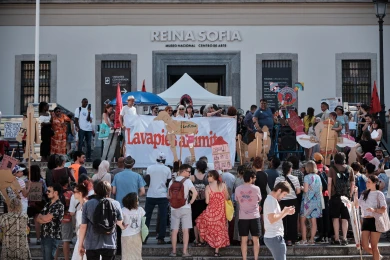
The School of Transformative Institutionalism and Local Organisation (S.T.I.L.O.) is a programme of joint learning and join strategy which sets in motion a process for the exchange of questions, methodologies and experiences between cultural organisations. The overall aim is to create, circulate and prototype tactics, tools and collective knowledge on institutional practices that open new channels for defending culture and advocating structural transformation in divergent geographical contexts.
The project is part of the Laboratorio de Institucionalidad Compartida (The Laboratory of Shared Institutionalism, LIC), a space for the Museo Reina Sofía’s research, work and advocacy centred on developing, experimenting with and systemising practices, protocols and tools which contribute to a fairer and more liveable cultural ecosystem.
For many years now, so-called infrastructural critique in museums questions material, legal and economic infrastructures, among others, as well as the forms of solidarity and practices required to sustain the cultural ecosystem. By approaching current debates, S.T.I.L.O. raises questions on the ways in which organisations define and interpret their practices, organise their relations and respond to the social contexts in which they operate.
The school gathers four cultural organisations that work via different institutional models – scale, contexts, conditions, different working models — with the goal of pooling common strategies and tools of organisation, advocacy and relationships with local communities.
The programme is conceived as a collaborative process with the participation of Arika, La Revuelta, BAK Basecamp and The Tentacular Museum (Museo Reina Sofía) and is structured around preparatory online sessions and an in-person seminar in Madrid.
S.T.I.L.O. is an activity framed inside the working strand of Situated Organisations from L'Internationale’s Museum of the Commons project, which reflects on the role of museums and art organisations as actors within complex social networks and ecosystems, with a view to exploring new ways to democratise institutions and make them more open, inclusive and useful.