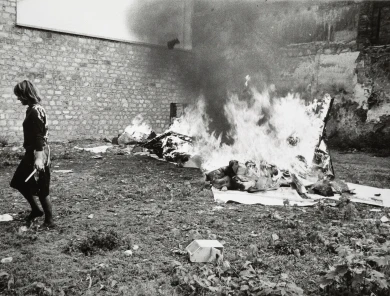
Marta Minujín, La Destrucción (The Destruction), 1963. Getty Research Institute, Los Angeles (2014.R.20)
Donation by the Roy Lichtenstein Foundation, in memory of Harry Shunk and Janos Kender. Photograph: Shunk-Kender © J. Paul Getty Trust
Across more than six decades, Marta Minujín (Buenos Aires, 1943) has shaped one of the most unique trajectories in Latin American contemporary art, earning her the maximum distinction from Spain’s Ministry of Culture: the Velázquez Prize, in 2016. The work of Minujín, a key figure of happenings, installations and participatory practices, flows beyond traditional categories of art to question the limits between art and life, situating collective experience at the heart of art-making. The exhibition La Menesunda According to Marta Minujín reconstructs one of her pivotal works, today regarded as a groundbreaking landmark in the history of immersive installation from the second half of the twentieth century.
Created in 1965 by Marta Minujín and Rubén Santantonín for the Centre of Visual Arts at the Instituto Torcuato Di Tella de Buenos Aires, to the backdrop of the major conceptual experimentation and profound cultural transformation that was taking place in Argentina at the time, La Menesunda radically transformed the artwork-spectator relationship. Conceived by these artists as an ephemeral “environment”, it replaced contemplation with multi-sensorial experience, turning the exhibition space into a place of active participation. The version the Museo Reina Sofía presents now is the outcome of research conducted in 2015 by the Museo Moderno de Buenos Aires to reconstruct the work from photographs, footage and other materials, in close collaboration with Minujín. After being displayed in Buenos Aires and later at the New Museum in New York and Copenhagen Contemporary, this reconstruction, jointly carried out by the Museo de Arte Moderno de Buenos Aires and Tate Liverpool, is shown for the first time in Spain.
In lunfardo, slang from Río de la Plata in Argentina, menesunda means, in diverse elements, a “mixture”, “confusion”, “mayhem”. The term synthesises the spirit of a work that encompasses a diversity of artistic mediums and sensorial stimuli, directly involving those who immerse themselves in it and blurring the borders between art and daily life. La Menesunda amassed many of the concerns running through 1960s avant-garde movements: the possibility of entering the mind of a woman artist, the rise of mass culture, the media’s incorporation into artistic language, the central position of the spectator and the possibility of understanding art as a shared practice. Its radical nature not only re-shaped the way an exhibition is conceived, but also anticipated forms of art-making with a currency that continues to mould many contemporary practices.
In this instance, the presentation of La Menesunda in the Museo Reina Sofía is accompanied by a documentary survey devoted to the happenings, performances and participatory actions Marta Minujín worked on from 1963 to 1985 — by way of photographs, drawings and different archive materials, the show broadly illustrates the intensive process of experimentation that defined more than two decades of Action Art work. Following her time in Paris, where she encountered Nouveau Réalisme and shifted her attentions from painting to assemblage and performance art, Minujín developed some of her most radical work, alternating her practice between Buenos Aires and New York.
From actions such as Simultaneidad en simultaneidad (Simultaneity in Simultaneity), interventions in television and radio, to El pago de la deuda externa con choclos (The Payment of Foreign Debt with Corn), made in a collaboration with Andy Warhol, and the series Mitos populares desmitificándose (Demystifying Popular Myths), most notably El Obelisco de pan dulce (The Sweet Bread Obelisk) and El Partenón de libros (The Book Parthenon), her career has continually explored new forms of participation and intervention in public space.
More than sixty years after its creation, the capacity of La Menesunda to question the ways in which collective imagery is constructed remains intact. In a present marked by the relentless flow of images and the continued spectacle of daily life, this installation of installations still fashions an understanding of art not as a distant object of contemplation, but as an event that only properly exists when it is experienced: an aesthetic experience that affects the subjectivity of those that move through it. This questioning, with radical imagination, of the relationships between reality and representation recalls one of the key roles of a museum: to expand ways of seeing the world.
Artists
Organised by
Tate Liverpool and Museo de Arte Moderno de Buenos Aires
Collaboration
Comunidad de Madrid
Curatorship
Manuel Segade
Touring locations
Copenhagen Contemporary
Museo Reina Sofía
Tate Liverpool
Credit
Exhibition organised by Tate Liverpool and the Museo de Arte Moderno de Buenos Aires in collaboration with the Museo Reina Sofía. Touring exhibition: Copenhagen Contemporary and the Museo Reina Sofía.
Acknowledgements
Fundación Ama Amoedo
Radisson RED Madrid



Collaboration