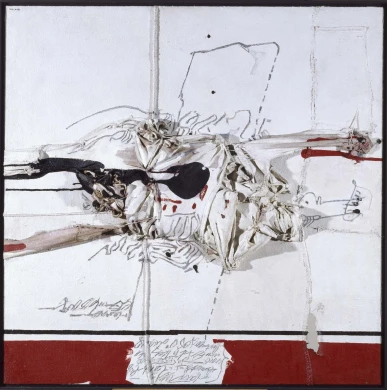
![Manolo Millares, Personaje caído I [Fallen Figure I], 1970, técnica mixta sobre arpillera, © Manolo Millares, VEGAP, Madrid, 2026](https://recursos.museoreinasofia.es/styles/small_portrait/public/Exposiciones/pieza-unica-millares.jpg.webp)
Manolo Millares, Personaje caído I [Fallen Figure I], 1970, mixed media on hessian
© Manolo Millares, VEGAP, Madrid, 2026
This year marks the hundredth anniversary of the birth of artist Manolo Millares (Las Palmas de Gran Canaria, 1926 - Madrid, 1972), a prominent representative of Informalism and a key figure in Spanish painting from the second half of the twentieth century.
Millares was born on 17 February 1926 in Las Palmas de Gran Canaria, on Ash Wednesday, which signalled the end of Carnival. From an early age, he was fascinated by his great-grandfather’s books on Canary Islands history and captivated by his visits to the Museo de Arte Canario, where he discovered the material remains of Guanche cultures, the Indigenous peoples of the Atlantic islands, particularly the markings of their ancient stamps and embalmed bodies in their burial sites.
From the early stages of his career, and his participation with the Canary Island group Los Arqueros del Arte Contemporáneo (LADAC, The Archers of Contemporary Art), Millares’s work was shaped by history and unites a deep-rooted passion for archaeology and a political and social commitment to a turbulent present. In 1955 he moved to Madrid with his wife, the painter and writer Elvireta Escobio, encountering the avant-garde of Abstraction. In 1957 —with Antonio Saura, Manuel Rivera, Luis Feito and Rafael Canogar, and others— he was one of the founders of the El Paso group, a movement which upheld “revolutionary visual production”, standing for a more determined drive towards the construction of Spanish contemporary art in the second half of that century.
The central concern in the artist’s mature work lies in a universal reference to the repression of totalitarian regimes, related to his experience of Francoist Spain, and to a twentieth century afflicted by violence and death. His painting is visceral, with an aesthetic of rupture, where ragged erosion co-exists with stitching as a ritual sign of reparation: “I make and remake the black box where all decay I denounce and bury every day is born and lies”.
Personaje caído I was made just two years prior to his untimely death, at the age of forty-six, during a time that witnessed his rise to international prominence. The picture folds into a crumpled volume, like the seams of a bandaged wound or the suspended body of a homunculus tangled in its burial cloth. The fabric is an agonised protest, almost under the shadow of a crucifixion; a dislocated painting with the tautness of a shroud stretched across a calm red horizon with a tone of dried blood. At this final juncture of his career, the volumetric wrapping, like the sacking of Alberto Burri’s paintings, hints at a graphic element Juan Manuel Bonet has compared to those employed by Antoni Tàpies and Cy Twombly: an enigmatic vocabulary reaffirming the illegibility of the same matter as canvas. From this violence, white emerges at once as grief and as hope. As in his greatest works, there are traces of finitude, in addition to the hopeful possibility of a renewal to come. “I believe my art slaps death to justify life”, Millares wrote.
The Reina conserves thirty pieces by Millares in its Collections, works encompassing graphic art, drawings and paintings. Notable among them are eleven works loaned by the Millares family, resulting from an ongoing collaboration and commitment to the public for which the Museo is deeply grateful.
Single Piece is a room centred on the temporary display of one work from the Museo Reina Sofía Collections. By shining a light on a single artwork, outside the framework of permanent-exhibition narratives, we can foreground aspects from the present day that cannot be overlooked and grant visibility to those cultures of support that contribute to a necessarily collective effort in building a public collection.
Artists
Organised by
Museo Reina Sofía
![Thomas Hirschhorn, Art Center 6 (Blow Down) [Centro de arte 6 (Reducción)], 2001, instalación, Museo Nacional Centro de Arte Reina Sofía. Donación de la Colección Meana-Larrucea. © Thomas Hirschhorn, VEGAP, Madrid, 2026](https://recursos.museoreinasofia.es/styles/small_landscape/public/Colecci%C3%B3n/01_0.jpg.webp)