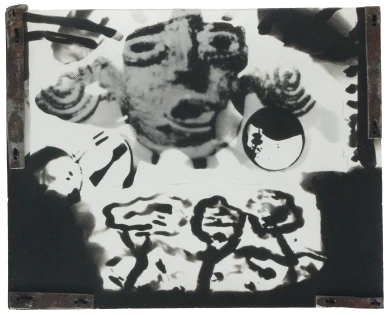
Miguel Ángel Rojas, DAMA CHIBCHA (CHIBCHA LADY), 1986, partially developed gelatin silver print, metal sheets and stitching, 35 x 38 cm
Courtesy Galería La Cometa
With a career spanning fifty years, Miguel Ángel Rojas (Bogotá, 1946) is widely recognised as a major figure in the Latin American art scene. His artistic trajectory is shaped by his examination of critical social and political themes in Colombia: from narco-trafficking and violence — often linked — to education, migration, decolonisation and the exploitation of natural resources. This recognition is also tied to his liberating approach to homosexuality and his journeys through cinemas where sexual encounters between unacquainted men occur. Equally, his works with photographic experimentation in the darkroom have led to pioneering works in which he incorporates aspects of his mixed-race/Indigenous heritage and his own homosexuality.
In The Night darkness moves from the half-light of projection rooms to the black of the charcoal the artist employs to create perceptible cartographies of eroded territories, in which he decries the ruin of the Amazon landscape, ravaged by capitalist extractivism. Miguel Ángel Rojas has always walked the margins, at the limits of the underworld, approaching tragedy while also initiating significant readings via messages with a deep-seated political and ethical commitment. Therefore, the show travels down a path that begins from the ramifications of the artist’s recent work before arriving at his own roots, in a perpetual search for the racial and sexual identity that brings him closer to stances of cultural intersectionality, and contributes to the definition of Rojas as a unique artist.
The exhibition, which presents a selection of salient works in his career, reflects the contrast between the retrieval of popular and native values and works that address the tragedy incited by Colombian narco-trafficking. Installations such as Grano (Grain, 1980), a work which, through its formal thematic experimentation, marked a breakaway in Colombian art in the early 1980s, puts forward a poetic, autobiographical reflection on country-to-city migrations in search of a better life. The artist, who grew up in Bogotá, sought to return to the rural origins of his family in the Tolima region, leading him to take different lands from this location and take them into a museum gallery, using it as a support, to create the ground of the dwelling where his grandparents lived. Conversely, works such as El camino corto (The Short Road, 2012) use resources akin to Pop Art and textual messages; through circular cuttings of coca leaves and dollar bills, this particular piece interweaves the names of international figures with widely recognised issues with drug use and the aliases of the most violent drug lords.
The show also affords insight into the dialogues, laden with intimacy and proximity, the artist develops with his subjects. The work David (2004) is one of the most painful examples of violence from the war in Colombia: through work with a soldier mutilated by an anti-personnel mine, Rojas creates an image which today is an emblem of victims’ pain. “The human body is the site, the sensitive place, the place of pleasure, pain, desires, phobias, conscience, the place of the mind”, he asserts. This body, blighted by cultural and economic violence, by inequality, is also the shadow of a social body that articulates the route through the exhibition.
Artists
Miguel Ángel Rojas
Curatorship
María Wills Londoño
Organised by
Museo Reina Sofía