Fugue of Ideas. Passion, knowledge and memory in Aby Warburg’s theory of the image. Seminar, 4 - 5 March 2011 at the Museo Reina Sofía
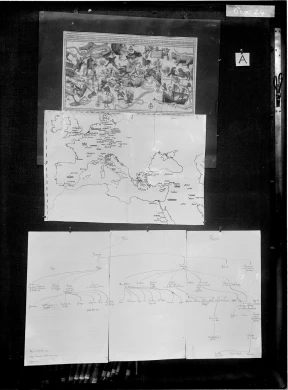
Javier Arnaldo, archivist and Head of Research and Extension Studies at the Museo Thyssen-Bornemisza and Professor of Art History at the Universidad Complutense de Madrid: I understand the Mnemosyne Atlas as a visual trial, an experiment, a way of ordering and systematising.
Claudia Wedepohl, Head Archivist, Warburg Institute, London: It was supposed to be the sum of all his work, but because of his death, he left just a fragment.
Matthew Rampley, Professor of Art History, University of Birmingham: It was only a fragment of what was originally planned.
Claudia Wedepohl: The fragment is very open to exegesis and hermeneutics because it was left without Warburg own interpretations.
Javier Arnaldo: It’s very enigmatic, but extremely productive.
Matthew Rampley: It consists of an atlas of some 60 plates, each of which contain a number of different images that trace the survival of symbols, or archetypes, from antiquity to their reworking in the Renaissance.
Lorraine Daston, Director, Max Planck Institute for the History of Science, Berlin: It is the kind of project that tries to erase the historical context.
Matthew Rampley: It’s the way that archetypes and visual symbols migrate transnationally to transhistorically.
Javier Arnaldo: The whole school of iconography around Panofsky and Gombrich, who worked with his legacy for many years and whose research went off in different directions.
Claudia Wedepohl: This is a cultural and historical view of the interpretation of the history of art. He considered himself an image historian rather than an art historian.
Lorraine Daston: The principles of grouping, separating, combining and comparing are morphological and not of substance. This creates a very different narrative to the history of art and the history of science.
Javier Arnaldo: The Mnemosyne Atlas is the sancta sanctorum of the history of images.
Claudia Wedepohl: We could even say that in iconic terms, Warburg is a founding father.
Lorraine Daston: It suggests surprising synergies and surprising insights that aren’t usually found in art history.
Matthew Rampley: These kinds of issues which are also linked institutionally to museums, collections and categorisations, but at a deeper level than the institutions that house them. I don’t think in many respects that Warburg really changed very much.
Claudia Wedepohl: I think we are living in his legacy, but not entirely. We need to remember that he was a scholar of the 19th century.
Matthew Rampley: An interesting aspect of Warburg’s work is a kind of blindness to politics, which is quite normal for this era among scholars, especially private scholars. He had a limited understanding of politics.
Claudia Wedepohl: He tried to conceive of the atlas as a work with too many dimensions to fit into a printed book.
Javier Arnaldo: Imaginary museums, museums without walls, open to compiling images from all times and places, atavistic elements in civilisation.
Lorraine Daston: The possibility of mixing. There’s even a new verb for this: morphing one into the other to reflect or reproduce the combinatorial logic of Warburg’s project.
Javier Arnaldo: It’s a visual experiment proposed as an alternative to the museum.
Lorraine Daston: Perhaps his form of working represents the inspiration that we need to take on this rich world of images in which we now swim.
Javier Arnaldo: It’s true that Warburg wouldn’t have been interested in museum shows with these characteristics.