-
Wednesday, 16 November 2022 Sabatini Building, Auditorium and online platform
Session 1
Online platform4:30pm - 4:45pm Presentation
Conducted by Mabel Tapia4:45pm - 8pm Fossil Capitalism
Round-table discussion with Clàudia Custodio, Erika González, Cara New Daggett and Jaime Vindel
—Moderated by: Adrián AlmazánLanguage: Spanish and English with simultaneous interpreting
The origins of the history of fossil capitalism date back to industrial modernity in the eighteenth and nineteenth centuries. Yet it appears that only recently — due to global warming and its catastrophic impact — have we gained some understanding of the critical dimension of its development. Although the forms of exploitation of bodies and nature have been a constant, the darker side of industrial modernity is embroiled in narratives of material progress, productivist ideology and techno-optimism. This round table analyses its historical genesis and contemporary drifts in relation to the emergence of new petro-fascist subjectivities, forms of necropolitical violence and the constitution of legal frameworks that grant it legal coverage.
-
Thursday, 17 November 2022 Sabatini Building, Auditorium and online platform
Session 2
Online platform4pm - 6:15pm Collapse or Possibility: Energy Crisis and Transition
Round-table discussion with Carlos de Castro, Llanos Mora and María Prado
—Moderated by: Jorge GauppClimate change and scant natural resources have led to the possibility of economic and systemic collapse. Facing this outlook, alternative technologies have been developed, most notably sources of renewable energy. This round table approaches a topical debate in university and public spheres: the scope of these energy options and their role in different settings of crisis — or continuity – in the current economic and political system.
6:15pm - 6:45pm Break
6:45pm - 9pm Eco-social Emergency and Political Strategy
Round-table discussion with Martín Lallana, Xan López and Carmen Madorrán
—Moderated by: Gemma BarricarteOn account of their objective harshness, scientific assessments on the environmental crisis tend to trigger turmoil which, despite being able to lead to a greater awareness of the severity of the situation and to mobilise the energy forms needed to contain it, also reinforce political paralysis, consumerist individualism and dystopian narratives which have cancelled out an imagining of other possible futures in recent decades. From a critical position in relation to narratives of eco-social collapse, this round-table discussion approaches different political strategies which, in the short- and long-term, must be on the table to channel contemporary social upheavals towards post-capitalist and post-Anthropocentric horizons of communal life.
-
Friday, 18 November 2022 Round-table discussion: Nouvel Building, Auditorium 200 and online platform; Screening: Nouvel Building, Auditorium 200
Session 3
Online platform11am - 2pm Transition and Counterculture 1: Environmental Memories
Round-table discussion with Chorche Paniello (Archive of Research and Documentation – the Sticker Recovery Centre), Alberto Berzosa and Ixone Sádaba
—Moderated by: Carolina EspinozaThe environmental movements that surfaced in Spain in the 1970s, from anti-nuclear protests, to struggles defending territory and biodiversity, to blockades to protest industrial development and pollution, managed to add eco-social concerns to the variegated programme of citizen tides which, from the foundations of society, drove forward political transition. These environmental mobilisations achieved significant landmarks, for instance halting the project to introduce nuclear power into the Basque coastline, starting with Lemóniz, and the creation of the urban park on the watercourse of River Turia in Valencia. However, despite these victories, environmental memory has not been part of narratives which, for over more than a decade now, have refuted the official history of the Spanish Transition. Further, recent works based on research in-with-from historical archives have started to build strategies to recover the memory of the movement, prioritising an approach to its visual culture. Four related works are thus presented in this session.
4:30pm - 6pm Transition and Counterculture 2: Cooperativa de Cinema Alternatiu
Presentation, documentary screening and talk with Joan Simó
—Presented by: Alberto BerzosaCooperativa de Cinema Alternatiu. Les energies
Spain, 1979, colour, original version in Catalan with Spanish subtitles, DA, 21'The film Les energies is the final production by Cooperativa de Cinema Alternatiu. A film which lays the foundations for the debate on the energy situation in Spain in the late 1970s, whereby the political agendas of the Spanish environmental movement and global eco-political mobilisation synchronised. After a brief summary of the evolution of energy from ancient times, the film renders an account of the main energy sources in Spain, the environmental impact of their production and the possible alternative guaranteeing some kind of energy sovereignty in a context of widespread crisis. Any similarity with the present is mere coincidence.
-
Saturday, 19 November 2022 Nouvel Building, Auditorium 200 and online platform
Session 4
Online platform10am - 12pm A Cultural Revolution: Twenty Years on from the Sinking of the Prestige
Round-table discussion with María Bella, Jorge Linheira and Daniel L. Abel
—Moderated by: Germán LabradorOn 19 November 2002, the Prestige oil tanker was shipwrecked off the Galician coast in what was regarded as the worst oil disaster in European history. The capacity for self-organisation by local residents and seafarers to contain the spill was coupled with a major associative and artistic deployment, reflected in demonstrations, poems, installations, performances, assemblies and burgeoning digital media. Thousands of volunteers offered, in record time, an exemplary citizen response, in contrast to the lies and irresponsibility of political leaders and institutional agents. Two decades on, members of the Unha Gran Burla Negra platform speak of their experiences in the care and activation of this critical, artistic and environmental legacy.
-
Saturday, 19 November 2022 Nouvel Building, Library and Documentation Centre, Space D
Session 5
Registration12:30pm Guided Tour Around the Documentary Show Cards on the Table: The Nunca Máis Movement and Political Decks of Cards
-
Saturday, 19 November 2022 Nouvel Building, Auditorium 200
Session 6
Online platform4pm - 6pm Environmental Encyclopaedia: Wikipedia Edit-a-thon
The aim of this workshop, led by two facilitators from Wikimedia Spain, is the creation and improvement of Wikimedia entries on the concepts worked upon during the congress. In line with Wikimedia’s working method, the workshop is open to any participant, enabling them to contribute to disseminating knowledge around critical ecology on the most visited online encyclopaedia in the world and to acquire the most important skills to edit Wikipedia.
Tides and Disasters
Critical Ecologies Encounter

Held on 16, 17, 18, 19 Nov 2022
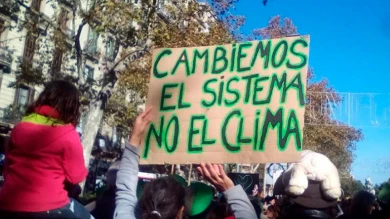
The sinking of the Prestige in 2002 demonstrated how the majority of contemporary environmental disasters give rise to significant mobilisations of mutual aid and demands in the places where they occur. In this four-day encounter, different researchers, artists, activists and citizens reflect on the relations between ecology, memory and democracy today. The programme revolves around four axes: environmental traditions stretching from the anti-Francoist struggle to the present; memory and citizen creativity following the Prestige oil spill; authoritarian threats that loom from the depletion of fossil fuels; and controversies around imaginable futures.
The encounter’s programme ties in with the CSIC research projects “Estética fósil: una ecología política de la historia del arte, la cultura visual y los imaginarios culturales de la modernidad” (“Fossil Aesthetics: A Political Ecology of Art History, Visual Culture and Cultural Imaginaries of Modernity”) (PIE 202010E005) and “Humanidades energéticas: Energía e imaginarios socioculturales entre la revolución industrial y la crisis ecosocial” (“Energy Humanities: Energy and Sociocultural Imaginaries Between the Industrial Revolution and the Eco-social Crisis” (PID2020-113272RA-I00, HUMENERGE).
[dropdown]
Adrián Almazán holds a PhD in Philosophy from the Autonomous University of Madrid and is a Philosophy lecturer at Carlos III University, also in Madrid. He has published the work Técnica y tecnología. Cómo conversar con un tecnolófilo (Taugenit, 2021) and participated in the collective book Ecosocialismo descalzo (Icaria editorial, 2018), in addition to writing numerous articles on the relationship between technology and politics from an eco-social perspective and on new ruralness as a civilising alternative.
Gemma Barricarte is an environmental and student activist who has been part of the Ecologistas en Acción, Fridays For Future and Xarxa per la Justícia Climàtica collectives. She is currently studying an MA in Interdisciplinary Studies on Environmental, Economic and Social Sustainability at the Institut de Ciència i Tecnologia Ambientals from Universitat Autònoma de Barcelona (ICTA-UAB). Her research centres on urban and territorial studies, political environmentalism and cultural and artistic studies.
María Bella is a researcher and cultural producer who holds a PhD in Curatorial Knowledge from Goldsmiths, University of London. She lives in Costa da Morte (Galicia), where she develops initiatives and cultural projects. She works with the cultural association Unha Gran Burla Negra, starting up projects on the construction, mediation and updating of the Archivo Vivo conserved by the association.
Alberto Berzosa holds a European PhD in Art History and Theory from the Autonomous University of Madrid and Université de Reims Champagne-Ardenne. He develops his work in a space where contemporary art, Spanish film history, and political and curatorial archives cross over. He is a researcher on the Estética fósil (Fossil Aesthetics) project from Spain’s National Scientific Research Council (SCIC) and a member of the Management Committee of Cost Action Traces as Research Agenda for Climate Change, Technology Studies, and Social Justice (TRACTS) from the COST Association in Brussels.
Carlos de Castro is a head lecturer in the Department of Applied Physics and a researcher in Energy, Economy and Systems Dynamics (GEEDS) at the University of Valladolid. His research focuses on the analysis and modelling of biophysical limits owing to problems related to energy and resources, climate change, the loss of biodiversity, and so on, along with the sociological and cultural “barriers” causing the collapse of this civilisation.
Clàudia Custodio is a member of the Swedish activist group Zetkin Collective, with whom she wrote White Skin, Black Fuel. On the Dangers of Fossil Fascism (Verso Books, 2021). She is currently a coordinator for Ecologistas en Acción on the campaign No a los Tratados de Comercio e Inversión (No to Trade and Investment Treaties), working specifically against the Energy Charter Treaty. She participates as an activist for climate justice with a number of collectives and has published articles on the movement.
Cara New Daggett is an assistant lecturer in the Political Science Department of Virginia Tech, where she conducts research into energy and environmental policies and feminist approaches to science and technology. She is the author of The Birth of Energy: Fossil Fuels, Thermodynamics, and the Politics of Work (Duke University Press, 2019), and has developed the concept of “petro-masculunity”, which highlights the relationship between masculinity, authoritarianism and fossil fuels. She has published work in journals such as Environmental Politics, Energy Research & Social Science and Millennium: Journal of International Studies.
Carolina Espinoza holds a PhD in Social Anthology from Spain’s National University of Distance Education (UNED), and is a Journalism graduate with a degree in Social Communication from Universidad de Concepción, Chile. She also has an MA in Economic Data from the Complutense of Madrid, an Iber-American MA in Information Services and Community Development in New Technologies from the University of Salamanca, and an MA in Anthropological Research and its Applications from UNED. She is currently an advisor in the Study Centre inside the Museo Reina Sofía’s Public Activities Department.
Jorge Gaupp is a political scientist at the Complutense University of Madrid who holds a PhD in Cultural Studies from Princeton University and an MA in International Development from the Complutense Institute of International Studies. He has published work on a range of themes such as regulation and the viability of solar energy in professional and educational journals like Era Solar, Suelo Solar and La Marea. He is currently an advisor in the Study Centre inside the Museo Reina Sofía’s Public Activities Department.
Erika González is a researcher in the Observatory of Multi-Nationals in Latin America (OMAL), a project promoted by the Paz con Dignidad Association. Her research work focuses on power and the impact and violation of human rights committed by transnational companies, particularly Spanish companies in Latin America. She is the co-author, with Pedro Ramiro, of the report Smurfit Kappa en Colombia: impactos socioecológicos y violaciones de derechos humanos (SumOfUs, OMAL and LASC, 2022) and the book A dónde va el capitalismo español (Traficantes de Sueños, 2019).
Germán Labrador is director of the Museo Reina Sofía’s Public Activities Department.
Martín Lallana is an eco-socialist activist in the anti-capitalist organisation Anticapitalistas and a pre-doctoral researcher in the group Industrial Ecology. Efficiency in the Use of Raw Materials from the University Institute of Mixed Research – CIRCE from the University of Zaragoza. He is currently writing his thesis Un futuro de baja demanda energética para España en 2050: escenarios y estrategias de descenso energético (A Future of Low Energy Demands for Spain by 2050: Scenarios and Strategies of Energy Reduction), and is the co-author, with Joám Evans Pim, of the report Reciclaje de metales. La alternativa a la minería (Recycling Metals. The Alternative to Mining, Mining Area, Ecologistas en Acción, 2022).
Jorge Linheira is head of the Service of Cultural Infrastructures for Pontevedra City Council, a researcher of cultural policies for the Provincial Government of A Coruña and co-founder of the cultural association Unha Gran Burla Negra. He also the author of La cultura como reserva india. Treinta y seis años de políticas culturales en Galicia (Libros.com, 2018).
Daniel L. Abel is an art historian and independent researcher, and the co-director of the Baleiro collecive (2008–2013). He is the co-author and co-editor of the books Canales alternativos de creación. Una aproximación crítica (Baleiro, 2012) and Canales alternativos de creación. Una aproximación histórica (Baleiro, 2013), and a co-founder of the cultural association Unha Gran Burla Negra.
Xan López is an activist and member of Contra el Diluvio, a group of study, reflection and action on climate change and its effects on the majority.
Carmen Madorrán holds a PhD in Philosophy, an MA in Bioethics and Law from the Universitat de Barcelona (UB) and a university MA in Criticism and Philosophical Argumentation from the Autonomous University of Madrid (UAM). She is a lecturer in the Philosophy Department from the Faculty of Philosophy and Literature at UAM. Furthermore, she directs the UAM-Demospaz School and coordinates the research group in Environmental Humanities from UAM (GHECO). Her research centres on contemporary political and moral reflections within the context of eco-social crisis.
Llanos Mora is a lecturer in the Department of Computing Languages and Science at the University of Málaga and holds a PhD in Physical Science from the Complutense University of Madrid. She is also the vice-president of Fundación Renovables (the Renewables Foundation). She has participated in over twenty projects of national and international research, published more than 100 articles in high-impact journals and for international conferences and has worked with researchers from universities from all over the world.
Chorche Paniello is the coordinator of the Archive of Research and Documentation – the Sticker Recovery Centre, which aims to locate, archive and document political and social stickers published from 1975 to the present day by political parties, unions and citizen and solidarity associations and collectives, among others.
María Prado is a forestry engineer at the Polytechnic University of Madrid and coordinates the campaign in the Energy and Climate area for Greenpeace España. She has fifteen years’ experience in the renewable energies sector with different companies and institutions.
Ixone Sádaba is an artist and photographer who received an MFA from the International Center of Photography in New York. Her work is defined by an obsession with representing diverse forms of violence. She has exhibited work at Museo Guggenheim in Bilbao, Museo Reina Sofía, the Museum of Contemporary Art (MOCA), Toronto, and the Museum of Contemporary Art, in New Orleans.
Joan Simó is the co-founder of Central del Curt and Cooperativa Cinema Alternatiu, both in Barcelona. He was awarded the National Videography Prize in 1991 for Best Producer by the Culture Department of the Generalitat de Catalunya, and is a member of the Communication Department from the Agència d’Energia at Barcelona City Council and the Consorci d’Educació de Barcelona.
Mabel Tapia is the deputy artistic director of Museo Reina Sofía.
Jaime Vindel is a researcher on the Ramón y Cajal Grants programme of the Institute of History from the Spanish National Research Council (CSIC), where he directs the research projects Estética fósil (Fossil Aesthetics) and Humanidades energéticas (Energy Humanities). He is the author of Estética fósil. Imaginarios de la energía y crisis ecosocial (Arcadia, 2020).
[/dropdown]
Organised by
Museo Reina Sofía and the research projects "Estética fósil" (PIE 202010E005) and "Humanidades energéticas" (PID2020-113272RA-I00, HUMENERGE) from CSIC’s Institute of History
Coordinated bu
Alberto Berzosa and Jaime Vindel
Inside the framework of
TIZ 6. Planet A: Green World
Participants
Participants
![Platform against A Burla Negra [The Black Mockery]. Ace of Cups from A baralla do Prestige [The Prestige Pack], 2002](https://recursos.museoreinasofia.es/styles/small_landscape/public/Actividades/cartas_snippet_2_0.jpg.webp)
![Ángel Alonso, Charbon [Carbón], 1964. Museo Reina Sofía](https://recursos.museoreinasofia.es/styles/small_landscape/public/Actividades/perspectivas_ecoambientales.jpg.webp)
![Alvin Langdon Coburn, The Coal Cart and the Tower [El carro de carbón y la torre], ca. 1911 / Copia póstuma, 2002, Museo Reina Sofía](https://recursos.museoreinasofia.es/styles/small_landscape/public/Actividades/la_imposible_transicion_energetica.jpg.webp)
![Basel Abbas y Ruanne Abou-Rahme, At Those Terrifying Frontiers Where the Existence and Disappearance of People Fade Into Each Other [En esas fronteras aterradoras donde la existencia y la desaparición de personas se disuelven entre sí], 2019](https://recursos.museoreinasofia.es/styles/small_landscape/public/Colecci%C3%B3n/abbasabourahme.png.webp)
Más actividades
![Mike Nichols, The Graduate [El graduado], 1967, película](https://recursos.museoreinasofia.es/styles/small_landscape/public/Actividades/ciclocine-piscinas-9_0.jpg.webp)
Mike Nichols. The Graduate
Friday, 31 July 2026
Benjamin Braddock (Dustin Hoffman) is a young graduate from a wealthy California family. After returning home he meets Mrs Robinson (Anne Bancroft), who seduces him in successive encounters and shows him things that can’t be read in books. Mrs Robinson’s daughter, Elaine (Katharine Ross), enters his life to turn his feelings upside down.
Anne Bancroft’s remarkable performance shows the need to feel alive in a world gone stale, and the weapons sex possesses opposite romantic love. This is the learning curve young Ben experiences, and it is the time he spends drifting in the swimming pool that takes him from bewilderment to lucidity. He goes from a fool in a wetsuit lost at the bottom of the pool, to letting himself sway on the waters of pleasure or to see the mantle of the pool covered in fallen leaves with the arrival of love. The swimming pool is the place that initiates a change of state: an awakening of life forces.
Sol Iglesias. The Swimmers
Saturday, 1 August 2026
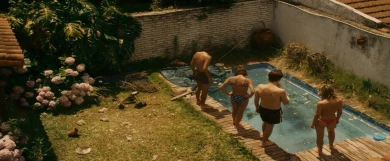
The end of the world, caused by climate change, is here and a group of friends wander from swimming pool to swimming pool at the height of a long, hot summer in Buenos Aires. From pool to pool, they cross the city, drifting leisurely and agreeably. In this transit they encounter different survivors searching desperately for water until their journey ends.
In echoing Frank Perry and Sydney Pollack’s film The Swimmer, Sol Iglesias’s The Swimmers is, equally, a path towards first light. The swimming pools symbolise, on this sunburnt stage, a metaphor at once for shelter and death by asphyxiation. It is the extreme heat that turns it into a fresh and pleasurable ending. The swimming pool, moreover, represents the lethargy of a youth tired of fighting against something they see as “inevitable”. As the young people trespass on a neighbourhood’s private property — rather than in public space — the pool is a stronghold of intimacy that must be seized: the false paradise of a collapsed society. The film brings the viewer closer to another film to feature in this series, La ciénaga (The Swamp, 2001) by Lucrecia Martel, in which bodies search for recesses of stagnant water.
Jack Hazan. A Bigger Splash
Friday, 7 August 2026
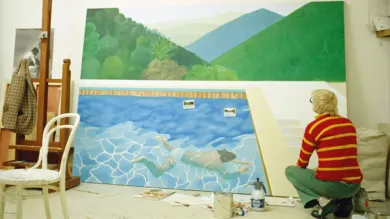
Painting endows a fleeting and unique moment with permanence and stability. This was the vision of the late David Hockney when, brushstroke by brushstroke, he returned to the swimming pool in A Bigger Splash: the great dive into a Californian pool which freezes a sense of happiness. A splash made by Peter Schlesinger, the painter’s partner from whom he has just separated.
In the film A Bigger Splash, Jack Hazan portrays the world of a successful artist, art-market and art-dealer pressure, the tension between the ego and personal frailty, and the obligation to continue with a style and iconography which, despite its instantly recognisable artistic imprint, creates doubts for the painter. In a grey, rainy London, a glum Hockney, the victim of soured love, keeps returning to the Californian swimming pool that holds the promise of happiness, in the form of a homosexual Arcadia in which the painter lives with his young partner and a group of equally glowing and attractive friends. Ultimately, the pool, as Jack Hazan recalls in this pioneering artist’s documentary, is a simile for the same painting in its original intention: hang onto fleetingness to lend it a permanence for the beholder, despite it not existing. Hockney, as one of the last great painters, knew his medium remained largely unchanged across hundreds of years of history.
Six Swimming Pools. A Dive into Experimental Film
Saturday, 8 August 2026
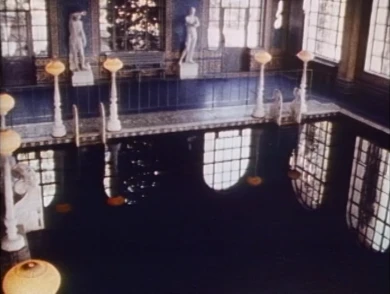
For the first time, the Museo’s summer cinema programme includes an experimental film section, centred on the experience and feeling of bodies under water. This session glides between the ostentatious aquatic architecture of Barbara Hammer and Barbara Klutinis and Jakobois’s fantasies, fleeting contact and wet, sexualised bodies. Six completely different swimming pools — private, public, transparent, bottomless, indoor, outdoor — all designed for leisure, competition and desire, nonetheless. A journey ranging from the monumentality of architecture to the intimacy of wet bodies.
Pools, by Barbara Hammer and Barbara Klutinis, turns swimming pools designed by pioneering architect Julia Morgan for the castle of tycoon William Randolph Hearst — the inspiration for Citizen Kane — into a space of play, bodily exploration and queer appropriation, an excuse to dive into a scene reserved for privilege. In An Algorithm, Bette Gordon fragments a series of headfirst dives and turns the sporting gesture into a visual score of repetitions, variations and rhythms. Tony Hill’s Water Work seduces with perspective, reflections and depth — the swimming pool as optical illusion, as an unstable surface which distorts and multiplies the gaze. Cheap Imitation “They Walk and I Walk”, by Rickard Eklund, submerges the camera to capture a choreography of synchronized bodies, a dance suspended under water. Naked bodies that dodge, twist and embrace in a space seemingly with no gravity combine in Gunilla Leander’s All Under. Passage du désir, by Jakobois, closes the programme with a montage in which water is no longer an environment, becoming instead a territory of desire.
Dominga Sotomayor. Debajo and Thais Fujinaga. A Felicidade das Coisas
Friday 14 August 2026
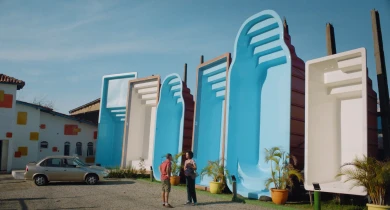
Two gems, from two new voices in Latin American cinema, which swing between families, swimming pools, reencounters and status. In Debajo, a short film on youth by Chilean director Dominga Sotomayor, an abstract yet powerful bird’s-eye view of a swimming pool co-exists with the relationships of a crisis-stricken family, gathered to see an eclipse. Sotomayor’s distinctive film-making of care and affects shares a similar space to the daily naturalism of Thais Fujinaga’s A Felicidade das Coisas. In the director’s first feature film, the swimming pool is not a horizontal basin for swimmers’ immersion; rather it is a huge vertical monolith, a kind of an anti-monument, anchored in the garden of a middle-class family. The film conveys the efforts and challenges of a mother of two children to build a swimming pool in their modest summer house, a mother who, alone, comes up against a hypermasculine world. Equally, the film speaks of family love, and the search for status, with the swimming pool a languishing totem of the Brazilian middle class during the years of Bolsonarism.