The Laboratory of Shared Institutionality
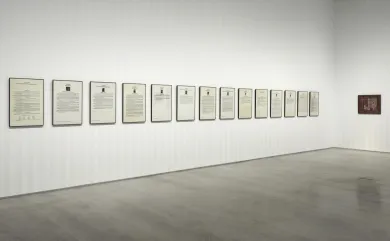
Hans Haacke, Seurat's "Les Poseuses" (Small Version), 1888–1975, 1975. Museo Reina Sofía.
Photograph: Museo Reina Sofía
The Laboratory of Shared Institutionalism (LIC in its Spanish acronym) is a space for research and collective work through which the Museo Reina Sofía develops advocacy tools together with the cultural ecosystem. To this end, three core strands serve as working horizons, all encompassing a commitment for structural impact on different scales, spanning from collaboration with other institutions in European spheres to work with local associationism. These horizons are climate justice and ecological transformation, a recalibrated cultural infrastructure, and cultural rights and accessibility, with each strand unfolding through different practices, devices, tools, and methodologies.
In recent decades, the Museo has experimented with different forms of political and institutional advocacy by supporting citizen demands and those of the art sector, in addition to consolidating a networked working methodology which is key to acknowledging the role of the museum as part of a broader cultural fabric. The LIC draws on these experiences to continue operating in a trans-scale way, opening strategy and discussion spaces between sector organisations and promoting undertakings which are set up to transform the conditions and structures that organise the cultural ecosystem. More About LIC.
Climate Justice and Ecological Transformation

Activación del Jardín de las Mixturas en el seminario Archivos del Común V. Memorias fúngicas
Museo Reina Sofía, 2023. Fotografía: Román Lorés
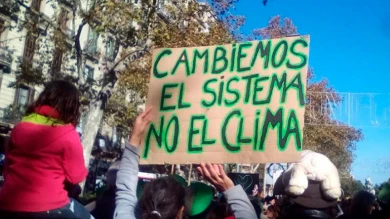
The eco-social crisis forces us to rethink the material conditions that make cultural activity possible and to recognise the relations of interdependence that link institutions to the territories and communities of which they are part. From this perspective, a museum’s ecological transformation actively seeks to minimise its environmental impact, while reconsidering ways of making from an ecological organisational practice which is attuned to the sustainability of processes in time and the capacities of teams and resources. The museum, as part of a broader cultural fabric, bears an ecological responsibility that spreads through its operations and working methodologies, thereby opening spaces to think collectively about conditions of culture’s eco-social transformation.
The Museo Reina Sofía articulates this alignment towards climate justice through a transversal working group in which workers from its different departments participate, enabling it to become a space from which to progressively incorporate ecological transformation into institutional practice as a whole.
Publications
- Depczyński, J. y Stefańska, B. (Eds.). (2026). Doing It with Others: A field report from our struggle to ecologize art institutions. L'Internationale Online. https://internationaleonline.org/publications/doing-it-with-others/
- Aikens, N. y Mabaso, N. (Eds.). (2026). The Climate Reader: Propositions, poetics, operations. L'Internationale Online. https://internationaleonline.org/publications/the-climate-reader-propositions-poetics-operations/
- Chu, H., Down, M., Mabaso, N., Martínez, P. y Oprea, C. (Eds.). (2022). Climate: Our Right to Breathe. L’Internationale Online y K. Verlag. https://www.internationaleonline.org/publications/climate-our-right-to-breathe/
- Werkmeister, S. y L’Internationale Online (Eds.). (2016). Ecologizing Museums . L’Internationale Online. https://www.internationaleonline.org/publications/ecologising-museums/
- Susan Schuppli. Playing Back the Histories of Climate Change, RRS (2017). https://www.museoreinasofia.es/radio/susan-schuppli
- Pedagogías del mañana. Ecofeminismos con Yayo Herrero, RRS (2024). https://www.museoreinasofia.es/radio/yayo-herrero
A Recalibrated Cultural Infrastructure
Cultural practice is upheld on material, legal, economic, organisational and symbolic infrastructures that determine its realities as much as its conditions of possibility — conditions which, far from being a neutral background, are a field of political and institutional intervention. From this perspective, the contemporary cultural institution can be understood at once as a cultural space and political and material infrastructure, as a place with a confluence of economic forces, geopolitical transformations, environmental conditions, labour relations and different conceptions of the public. Institutions are not only conditioned by these forces; through their forms of funding, hiring, governance, maintenance, programming, acquisitions and access they actively participate in their production and reproduction.

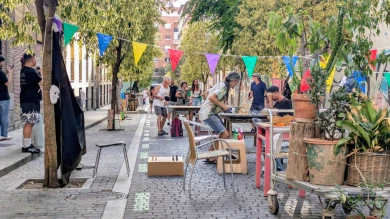
Chiquipicnic del barrio de Museo Situado, Museo Reina Sofía, 10 de junio de 2023
Fotografía: Paula Lorenzino
Framed in this context, recalibrating involves mounting sustained processes of reorganisation within complex structures, dealing with interdependencies on different scales and margins of action. Opposite the idea of total and immediate transformation, recalibration operates through specific interventions with the capacity to displace practices, review procedures, redistribute resources and capacities and progressively modify the conditions that organise the cultural ecosystem. Therefore, it entails developing forms of institutional knowledge and technical capacity that can be collectively actionable.
This strand addresses the material, technical and symbolic conditions that make art and cultural work possible, as well as the museum’s public and political role in contemporary society. In this vein, the Museo Reina Sofía propels long-term processes and participates in structures and alliances oriented towards the development of research themes and advocacy tools capable of contributing to normative changes for the sector and to intervene in formulating cultural policies, in both state and European spheres.
Tools, Networks and Devices
Programmes
Publications
- Aikens, N., Buraya Boned, S., El Khatib, L., Esche, C., Pogačar, M., Țichindeleanu, O. y Yurteri, E. (Eds.). (2025). Collective Study in Times of Emergency. L’Internationale Online. https://www.internationaleonline.org/publications/collective-study-in-times-of-emergency/
- Zielińska, J. (Ed.). (2022). Performing Collections. L’Internationale Online. https://internationaleonline.org/publications/performing-collections/
- Cabeza de Vaca, F. MM., Olascoaga, S. y Železnik, A. (Eds.). (2022). From/To. Letters From/To the Constituent Museum. L’Internationale Online. https://www.internationaleonline.org/publications/from-to-letters-from-to-the-constituent-museum/
- Byrne, J., Morgan, E., Paynter, N., Sánchez de Serdio, A. y Železnik, A. (Eds.). (2018). The Constituent Museum. Constellations of Knowledge, Politics and Mediation. L’Internationale y Valiz. https://www.internationaleonline.org/publications/the-constituent-museum-constellations-of-knowledge-politics-and-mediation/
- Aikens, N., Lange, T., Seijdel, J. y ten Thije, S. (Eds.). (2026). What's the Use. Constellations of Art, History, and Knowledge. A Critical Reader. L’Internationale y Valiz. https://internationaleonline.org/publications/whats-the-use-constellations-of-art-history-and-knowledge/
- Museo Situado. Una conversación con Ana Longoni [Audio]. (2020). RRS. https://www.museoreinasofia.es/radio/museo-situado-ana-longoni
- Museo en Red. Tejiendo ecosistemas. (2021). Carta(s). https://www.museoreinasofia.es/publicacion/cartas-7-espanol
- Desacuerdos. Sobre arte, políticas y esfera pública en el Estado español [Audio]. (2016). RRS. https://www.museoreinasofia.es/radio/desacuerdos
- Rodrigo, J. y Esta es una plaza. (2013). Pedagogías colectivas y prácticas instituyentes [Audio]. RRS. https://www.museoreinasofia.es/radio/pedagogias-colectivas-practicas-intituyentes
- Asociación de Mediadoras Culturales de Madrid (AMECUM). (2023). Un lugar donde encontrarse. De las condiciones materiales de la Mediación Cultural y sus posibilidades de transformación. MAR. https://marplataforma.org/recursos/un-lugar-donde-encontrarse-de-las-condiciones-materiales-de-la-mediacion-cultural-y-sus-posibilidades-de-transformacion/
Cultural Rights and Accessibility

Mediación en bengalí de la exposición Aurèlia Muñoz. Entes durante el Picnic del barrio 2026. Mediadora: Sadia Mahfuz, Museo Reina Sofía
Fotografía: Sue Ponce
LIC seeks to work from an expanded notion of accessibility, understood as a transversal principle of institutional practice. From an intersectional perspective, accessibility involves recognising that the possibilities of participating in cultural life are traversed by different bodily and cognitive conditions, and by social and cultural inequalities that condition access. Consequently, it raises the question of which conditions widely and heterogeneously make possible participation in the institution and its cultural life.
This perspective displaces attention from bringing down barriers towards building conditions of participation and autonomy. Thus, accessibility affects the museum’s spaces and devices, and its languages and ways of relating. Understood as such, it bears a direct relation to cultural rights: the effective possibility of accessing culture and being involved in its production from different stances, experiences and forms of knowledge.
In the Museo Reina Sofía, this strand is developed through institutional policies and specific tools, including the Equality Plan and the Cultural Rights Plan, in dialogue with networks of research and practice. An internal transversal group, comprising workers from the Museo’s different areas, drives this process and is part of progressively incorporating accessibility into the organisation as a whole and into institutional practice.
Networks, Tools and Devices
- The Network of Museums for Equality
- Redes Ling
- Museo Situado
- Spanish Language School for the Migrant Population
- The School of Rights
- Escuela de Mediación Situada Aissatou Ndiaye (in Spanish)
- University Micro-Credential in Intercultural and Multilingual Mediation within Artistic Contexts
- Activities and resources around accesibility (in Spanish)
- Activities and resources for children and families (in Spanish)
- Activities and resources for older people (in Spanish)
- Activities and resources for young people (in Spanish)

Publications
- Buraya Boned, S. (2025). Por un museo-escuela de saberes de lo común. La Laboratoria. Revista de Ciencias Humanas, 2, 61-71. https://revistasacademicas.unsam.edu.ar/index.php/lb/article/view/2024/4330
- Zelco, D., Razib, R. H., Rhaman, A., Fazle, E. M. y Torres Pérez, P. (2020). Reunión. Lengua o muerte. Museo Reina Sofía. https://www.museoreinasofia.es/actividad/dani-zelko
- Zelco, D. y Sindicato de Manteros. (2023). Reunión. Mame Mbaye. Museo Reina Sofía. https://www.museoreinasofia.es/actividad/dani-zelko-mame-mbaye
- Yásnaya Elena A. Gil. El futuro que pensemos tiene que ser multilingüe. (2025). RRS.
https://www.museoreinasofia.es/radio/yasnaya-elena-gil - Diversexx[y]s: conversaciones en torno a diversidades y sexualidades. (2015). Museo Reina Sofía. https://www.museoreinasofia.es/multimedia/diversexxys-conversaciones-torno-diversidades-sexualidades
- Activando Triángulo Rosa. Materiales didácticos y propuestas pedagógicas para una escuela diversa. (2022). Museo Reina Sofía. https://www.museoreinasofia.es/publicacion/activando-triangulo-rosa
More About LIC
In different formats, ranging from study groups to work clinics, LIC reflects on the systemic challenges that extend across the culture sector, while examining organisational models and operational structures to test methodologies of institutional intervention, both in the Museo and in collaboration with other initiatives and networks of practice.
As a key part of culture’s system and infrastructure, art institutions are pervaded by art market circuits, real estate and urban transformation dynamics, the financialization of daily life, the weakening of public infrastructures, the precarization of labour in culture, an the increase of different forms of inequality and a deepening eco-social crisis. This is in addition to the international rise of authoritarian and excluding politics, and an intensification of cultural wars, which have turned culture, critical knowledge and the definition of the public sphere into territories of dispute.
At the same time, cultural institutions continue to assume a series of public responsibilities: facilitating access to culture and knowledge, safeguarding cultural heritage and legacies, supporting those creating culture, upholding spaces of research and collective reflection and critically responding to social transformations. These roles cannot be understood in isolation from the material and organisational conditions of institutional life, for programming, governance, work, resources and infrastructure are interdependent dimensions of cultural practice.
At this current time in history, the traditional separation between infrastructural operations and cultural programming — the backstage and the frontstage of institutional life — is becoming increasingly less sustainable. Therefore, there is a need to design strategies that treat both aspects as mutually constitutive and which allow for the development of new institutional literacies, technical capacities and forms of cooperation between agents from the ecosystem to undertake major processes of structural transformation.
Contact