Session 1. On Images and Refusal. Carte Blanche to Eli Cortiñas
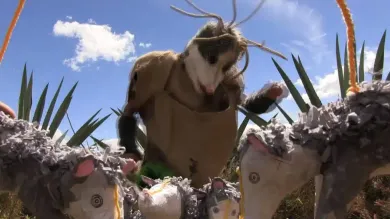
Naomi Rincón Gallardo, Resiliencia Tlacuache (Opossum Resilience), 2019, film
The first session begins with the screening of The Lighting (2021), a video art piece by artist Musquiqui Chihying which orbits around the material conditions necessary for visibility. The artist transfers the matter of representation over to image production apparatus — while Togolese photographers describe specific work for photographing dark skin, photographic films and face recognition systems reveal the bodies for which these technologies were historically designed.
In Josèfa Ntjam’s Matter Gone Wild (2023), revolutionary figures, plant matter and biomorphic beings converge in a speculative ecology and form dissident alliances between colonial histories and different temporalities. Ntjam transforms absence and unresolved inheritances of archive into generative matter, rather than repairing it, thereby lending it an illusory coherence. Memory does not emerge as a stable deposit of the past, but is a relational, mutating field continually recomposed between forms of human and non-human life capable of producing other genealogies, identities and futures.
You May Own the Lanterns but We Have the Light (2022), by artist Haig Aivazian, shows a city plunged into darkness after a blackout. On the one hand, public lighting organises movement and works as a technology of surveillance and control. On the other, darkness shelters dreams, ghosts, forms of gathering and escape routes. Made up of fragments of animations found and re-drawn by the artist, the work presents visibility not as an acquired right or guarantee of recognition, but as a regime which determines which bodies become identifiable and traceable and which forms of gathering, escape and resistance can persist out of their reach.
In Not Gone with the Wind (2020), artist Eli Cortiñas explores different visual cultures and their social and political effects to trace how bias across history is inserted, silently, into new technologies. With the incorporation of “not” into the original title of the famous film, Cortiñas sets forth a critique of the long Hollywood tradition which, in her view, perpetuates racist and sexist imagery with full impunity.
The “Coyolxauhqui imperative” by Chicana writer and theorist Gloria E. Anzaldúa is a philosophical and political concept that presents transformation as a task of recomposing the fragmented without erasing the wound. In Resiliencia Tlacuache (Opossum Resilience, 2019), Naomi Rincón Gallardo situates this work of reconstruction in Oaxaca, where different ways of life inhabit temporalities of creation and extractivist conflict. Faking death and returning to life become a technology of resistance to survive destruction and reopen the future.
Inside the framework of
Organised by
Museo Reina Sofía



Accessible activity
This activity has two spaces reserved for people with reduced mobility
Agenda
jueves 24 sep 2026 a las 19:00
First Session
— With a presentation by Eli Cortiñas
jueves 01 oct 2026 a las 19:00
Second Session
PROGRAMME
Musquiqui Chihying. The Lighting
Germany, Taiwan, Togo, 2021, DA, colour, sound, original version in English, French and Mandarin, with Spanish subtitles, 21'
Josèfa Ntjam. Matter Gone Wild
France, 2023, DA, colour, sound, original version in French with Spanish subtitles, 19'
Haig Aivazian. You May Own the Lanterns but We Have the Light
Lebanon, 2022–2025, DA, black and white, sound, original Arabic version with Spanish subtitles, 11'
Eli Cortiñas. Not Gone with the Wind
Germany, 2020, DA, colour, sound, original version in English with Spanish subtitles, 9'
Naomi Rincón Gallardo. Resiliencia Tlacuache (Opossum Resilience)
Mexico, 2019, DA, colour, sound, original version in English with Spanish subtitles, 16'
![Musquiqui Chihying, The Lighting [La iluminación], 2021, película](https://recursos.museoreinasofia.es/styles/small_landscape/public/Actividades/1_1-corti%C3%B1as.jpg.webp)
![Musquiqui Chihying, The Lighting [La iluminación], 2021, película](https://recursos.museoreinasofia.es/styles/small_landscape/public/Actividades/1_2-corti%C3%B1as.jpg.webp)
![Musquiqui Chihying, The Lighting [La iluminación], 2021, película](https://recursos.museoreinasofia.es/styles/small_landscape/public/Actividades/1_3-corti%C3%B1as.jpg.webp)
![Musquiqui Chihying, The Lighting [La iluminación], 2021, película](https://recursos.museoreinasofia.es/styles/small_landscape/public/Actividades/1_4-corti%C3%B1as.jpg.webp)


Activity within the program...
On Images and Refusal. Carte Blanche to Eli Cortiñas
On Images and Disobedience. Carte Blanche Session: Eli Cortiñas is an audiovisual series curated by artist Eli Cortiñas (Las Palmas de Gran Canaria, 1979), in dialogue with her installation The Machine Dreams of Smoke, on view in the Museo Reina Sofía. The programme underscores the concerns and confluences of her creative world, and the crossover of political critique, post-internet delirium, protest film and contemporary theory. Moreover, it touches on narratives which unsettle, defy or question the hegemonic regime of the gaze, stretching across three sessions in which films and video works inhabited by imagery, disputing archives, technological systems and memories accommodated in bodies, non-human beings and the land are entwined. The image does not emerge here as a neutral surface upon which the world appears, but rather as a disputed territory where categories of the human are made: lives are illuminated, while others remain in darkness.
The artists' works reveal the way in which archives are often perpetuated with discourses established by power, escalating partial narratives as a kind of universal register. There is a need to activate other forms of memory: counter-archives articulated via rupture, the reassembling of what’s been dismembered, counter-narration and collective survival; archives which can restore value to lives and worlds which are violently excluded from the official narrative. That is, disobedience which, in accordance with sociologist Akwugo Emejulu in Fugitive Feminism (Silver Press, 2022), can be taken further — Emejulu speculates on a departure from the very category of the human: a political and philosophical project, historically constituted by white supremacy, whereby certain groups have not only been dehumanised, but were also never fully recognised as humans.
On Images and Refusal returns to this concept as it puts forward fugitivity as both a strategy to escape control and as a way of building relations, narratives and forms of appearance not subjected to conditions that engender exclusion. The rejection of oppressive systems and refusal both take on different forms: from playing dead in order to return, to making the fragile materiality of celluloid speak, to defending the land in which the dead are still present, even turning the instruments of image production against the histories they were built to sustain.
Expanding on the question of writer and researcher Bogna Konior: “And what if the very silence of the universe were not proof of absence, but intelligence?”, Eli Cortiñas’ carte blanche session reflects on silenced narratives and whether their interest lies in responding to margin/centre logics or if, conversely, these operate as autonomous systems that are not only subjected to hegemonic narratives, but instead produce spaces of resistance, ways of life and new epistemologies. Therefore, opposite the demand for all life to become legible, extractable and exposed, this series does not present opacity as a shortcoming, but as an active condition from which agency, life and knowledge emerge.
Ver programaSession 1. On Images and Refusal. Carte Blanche to Eli Cortiñas
Thursday, 24 September and 1 October 2026 - 7pm
The first session begins with the screening of The Lighting (2021), a video art piece by artist Musquiqui Chihying which orbits around the material conditions necessary for visibility. The artist transfers the matter of representation over to image production apparatus — while Togolese photographers describe specific work for photographing dark skin, photographic films and face recognition systems reveal the bodies for which these technologies were historically designed.
In Josèfa Ntjam’s Matter Gone Wild (2023), revolutionary figures, plant matter and biomorphic beings converge in a speculative ecology and form dissident alliances between colonial histories and different temporalities. Ntjam transforms absence and unresolved inheritances of archive into generative matter, rather than repairing it, thereby lending it an illusory coherence. Memory does not emerge as a stable deposit of the past, but is a relational, mutating field continually recomposed between forms of human and non-human life capable of producing other genealogies, identities and futures.
You May Own the Lanterns but We Have the Light (2022), by artist Haig Aivazian, shows a city plunged into darkness after a blackout. On the one hand, public lighting organises movement and works as a technology of surveillance and control. On the other, darkness shelters dreams, ghosts, forms of gathering and escape routes. Made up of fragments of animations found and re-drawn by the artist, the work presents visibility not as an acquired right or guarantee of recognition, but as a regime which determines which bodies become identifiable and traceable and which forms of gathering, escape and resistance can persist out of their reach.
In Not Gone with the Wind (2020), artist Eli Cortiñas explores different visual cultures and their social and political effects to trace how bias across history is inserted, silently, into new technologies. With the incorporation of “not” into the original title of the famous film, Cortiñas sets forth a critique of the long Hollywood tradition which, in her view, perpetuates racist and sexist imagery with full impunity.
The “Coyolxauhqui imperative” by Chicana writer and theorist Gloria E. Anzaldúa is a philosophical and political concept that presents transformation as a task of recomposing the fragmented without erasing the wound. In Resiliencia Tlacuache (Opossum Resilience, 2019), Naomi Rincón Gallardo situates this work of reconstruction in Oaxaca, where different ways of life inhabit temporalities of creation and extractivist conflict. Faking death and returning to life become a technology of resistance to survive destruction and reopen the future.
Session 2. On Images and Refusal. Carte Blanche to Eli Cortiñas
Thursday, 25 September and 2 October 2026 - 7pm
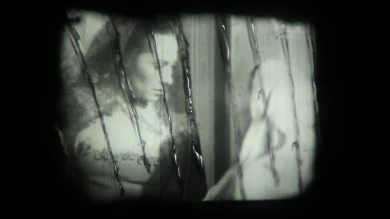
“Here they come, the headless, the maimed, the dismembered [...]”. A woman’s voice extends across Impresiones para una máquina de luz y sonido (Impressions for a Light and Sound Machine, 2014), by Colectivo Los Ingrávidos, naming bodies marked by femicide, disappearance and violence in the Mexican State. Behind the voice, an ageing film twitches, scars and seems to disintegrate. Voice and celluloid mutually leave imprints: the material frailty of film becomes inseparable from the dispute related to which of the dead enter in public memory. Thus, the damaged image carries a narrative that official history refuses to accept.
In Lemohang Jeremiah Mosese’s This Is Not a Burial, It’s a Resurrection (2019), memory does not lie only in testimony, but also in the land. Following the death of her son, the elderlt Mantoa readies herself to be buried beside her ancestors. Her mourning changes direction when she discovers that the fields and cemetery of her village in Lesotho will disappear under a dam. That which is hailed as development would separate the lives of the dead and would turn an inhabited territory into an exploitable resource. Mantoa’s grief becomes a challenge, and her wish to be buried there becomes the collective defence of a world whose value cannot be translated into the language of progress.
![Med Hondo, Soleil Ô [¡Oh, sol!], 1970, película](https://recursos.museoreinasofia.es/styles/small_landscape/public/Actividades/9_0-corti%C3%B1as.jpg.webp)
Session 3. On Images and Refusal. Carte Blanche to Eli Cortiñas
Saturday, 26 September and 3 October 2026 - 7pm
In The Machine Monologues (2024), by Eli Cortiñas, the voices of humanoid robots, avatars and chatbots circulate through systems organising everyday life. Inside them are fears, desires and residual human ideologies: anthropocentrism, extractivism, racialised classification and the dream that technological development can be disassociated with the violence upholding it. The machine speaks, yet its language reproduces the contradictions inherent in the human condition.
Med Hondo’s Soleil Ô (1970) depicts another machinery of representation: the colonial order and films which help to naturalise it. The film, following an anonymous African migrant on his arrival to France, confronts the racism that structures housing, work, sexuality, bureaucracy and national belonging. However, Hondo refuses to keep this experience contained within a conventional narrative of individual misfortune. Satire, animation, music, a direct questioning and changes of register break the narrative and connect the protagonist’s alienation to slavery, missionary violence, assimilation and the still-inconclusive persistence of empire. The anti-colonial force of Hondo’s fragmented film-making shows modern Europe as an assembled technology rooted in colonial conquest, his films becoming not only a mirror held up to history, but also an instrument with the capacity to disrupt its continuity: a polyhedral image capable of accusation, irony, disobedience and revolt. In Soleil Ô the sun does not just shine. It responds.
![Eli Cortiñas, The Most Given of Givens [Lo más dado de lo dado], 2016, instalación de vídeo de tres canales.](https://recursos.museoreinasofia.es/styles/small_landscape/public/Exposiciones/expo-eli-corti%C3%B1as.jpg.webp)
Más actividades
![Isabel Coixet, 100 Years and You Everywhere [100 años y tú en todos los sitios], 2026, película](https://recursos.museoreinasofia.es/styles/small_landscape/public/Actividades/2.diseminar-mundo.jpg.webp)
John Berger and Isabel Coixet. Continued Ways of Seeing
Thursday, 17 September 2026 at 7pm
Ways of Seeing (1972) is one of the most revolutionary television series on art history, the museum and contemporary critical culture. Across four episodes, an articulate, enthusiastic John Berger unpacks the relationships between classical art through the gaze and new technology, the nude and feminism, the oil painting and commodity fetichism, advertising and consumerism. In essence, a level of critical commitment only comparable to its capacity for dissemination. Unsurprisingly, the series, and the book that would distil it, continues to forge vocations. This session sees art historians Alberto López Cuenca and Modesta Di Paola carry out an analysis of Berger’s audiovisual work, placing the stress on episodes one and four of the series. In the first episode, Berger reflects on the connection between the act of seeing, looking and being in light of new technology, such as the film camera. At the same time, it analyses how the culture of reproduction is turning paintings into messages or fragments of communication while stressing the importance of silence when observing historical paintings. In the fourth and final episode, he introduces advertising as a new iconic-verbal language that shares certain principles with the message of oil painting as a luxury item.
The session opens with the premiere of a filmic letter from Isabel Coixet, one of Spain’s most internationally acclaimed directors, to John Berger, with whom she maintained a long friendship and deep admiration. The short film is testament to the ubiquitous and long-lasting presence of the author of Ways of Seeing, even after his death in 2017.
![Chantal Akerman, Woman Sitting after Killing [Mujer sentada después de matar], 2001, instalación. Museo Reina Sofía](https://recursos.museoreinasofia.es/styles/small_landscape/public/Actividades/chantal-akerman-mujer-sentada-despues-matar.jpg.webp)
On Your Screen: Art History and the Museum Facing the Audiovisual Challenge
18, 19 SEP 2026
The conference On Your Screen: Art History and the Museum Facing the Audiovisual Challenge sparks debate around the transformations of art history and museum space upon embracing the audiovisual format. Its starting point is John Berger’s emblematic television series Ways of Seeing (1972), a landmark in the democratisation of art-historical discourse. In the series, Berger illustrated how the transfer of a work such as Goya’s Los fusilamientos del 3 de mayo (The Third of May 1808 or the Executions) from museum gallery to home TV screen completely changed the viewer’s experience, allowing the image to travel to straight to the viewer.
In the twenty-first century, this screen-based ecosystem has expanded exponentially, with museums not only physically integrating screenings and devices into their galleries— following in the wake of many exhibitions on the moving image — but also deploying complex virtual strategies. Equally, numerous en vez de a multitudeof historians, students and creators use digital platforms to circulate their ideas and projects. This audiovisual shift opens access to ignored materials and democratises knowledge, as well as challenging traditional hierarchies and the interpretive authority of institutions. The conference, promoted by the research project ATLAS AV: The Audiovisualisation of Art History and the Museum, seeks to analyse this vast audiovisual material, its archives, and its capacity to transform the memory of art.
Godard and Miéville: Time and Ruin
Friday, 18 September 2026 - 7pm
Inside the framework of the conference On Your Screen: Art History and the Museum Facing the Audiovisual Challenge, this film series sets forth three critical visions of the museum via three sessions featuring the works of John Berger, Jean-Luc Godard and Anne-Marie Miéville, Ariella Azoulay, Alan Resnais and Chris Marker, Kwate Nee-Owoo, and the premiere of short films by Isabel Coixet and La Vulcanizadora (Maria Rojas Arias and Andrés Jurado). In classical theory, the museum gives the world meaning; it contains fragments of the past, granting them a history, a narrative that explains preterite time and the present. Today, there is an implicit assumption that this function hides and legitimises forms of power, yet what if the museum, instead of explaining the world, multiplied it through radical ideas, silenced periods and repressed subjects? Such is the approach of the film-makers and artists in this film season.
In 1972 the writer John Berger opened the landmark television series Ways of Seeing with an iconoclastic gesture: slicing Sandro Botticelli’s painting Venus and Mars (1485) in London’s National Gallery. A transgressive act that recalls contemporary attacks on the museum by dissident youth and with which Berger, after revealing it was a reproduction, sought to ignite debate around the idea of an original artwork and a copy. In this, the hundredth anniversary of his birth, the first session pays homage to one of the great art writers of the twentieth century. Starting with a review of Berger’s audiovisual work by art historians Alberto López Cuenca and Modesta Di Paola, the series begins with the premiere of 100 Years and You Everywhere (2026), an unreleased short film by Isabel Coixet composed as a beautifully crafted letter to Berger, and continues with an analysis of fragments of Ways of Seeing in relation to the museum and contemporary art.
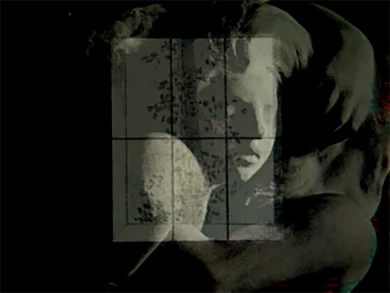
The second session screens two medium-length films by Jean-Luc Godard and Anne-Marie Miéville on time, ruin and museum. In The Old Place. Small Notes Regarding the Arts at Fall of 20th Century (1999), both film-makers consider what remains of that “old place”, the museum, at the close of a century of wars and totalitarianism, and ask whether it should be more of a legend or desire than a place. This same driving principle leads Godard to build his own imaginary museum in Reportage amateur (maquette expo) (2006), a rickety toy museum which, paradoxically, contains the great film-maker’s full power of thought on history and images.
Finally, the third session explores one of the major challenges of recent years: the decolonisation of the museum, the recognition of its link to imperialist discourses of power and the need to situate a new silenced or repressed subject at the centre of the Western narration of history. Under the title Museums and Restitution, it includes the film Undocumented. Unlearning Imperial Plunder (2019), by theorist Ariella Azoulay, Statues Also Die, by Alan Resnais and Chris Marker (1953), Kwate Nee-Owoo’s You Hide Me (1970) and the first screening of the short film Quinto verso, parte de Tonada (Fifth Verse, Part of Tonada), by La Vulcanizadora (Maria Rojas Arias and Andrés Jurado), filmed at the Museo de América in Madrid.
![Ariella Azoulay, Un-documented. Unlearning Imperial Plunder [Indocumentados. Desaprendiendo el saqueo imperial], 2019, película](https://recursos.museoreinasofia.es/styles/small_landscape/public/Actividades/5.diseminar-mundo.jpg.webp)
Museums and Restitution
Saturday, 19 September 2026 - 7pm
Centuries of plundering, decades of amnesia, years of living with unmitigated extractivist power… Does a museum, as we know it, have a raison d'être in a postcolonial society?
This session expounds the operations of the museum as a colonial machine, while putting forward ideas, in narration, for a more just, equal and inclusive institution of the future via society’s marginalised and minority voices. The session begins with the international premiere of Quinto verso, parte de Tonada (Fifth Verse, Part of Tonada), which presents a vision of the Quimbaya Collection (fifth and sixth centuries CE) from the Museo de América in Madrid. It is constructed with the voices and chants of Wayúu mourners and guides, not only as a way of reinstating the role of these gold idols — anthropomorphic figures of men and women used as vessels in ritual practices — but also to imagine that what must be exhibited is not the gold itself. It is the ritual’s own chant. In the classic film You Hide Me (1970), Ghanaian film-maker Kwate Nee-Owoo accesses the British Museum’s collection of African art, located in the building’s basement, to question the meaning behind a museum plundering and nullifying. A fine exercise of first-person institutional critique screened for the first time in Spain. Almost seventy years since Resnais and Marker made Statues Also Die (1953), a reflection on the aura-bearing value of the museum opposite the identity-based and cultural belonging of African art, theorist Ariella Azoulay films the same statues again at the Musée du Trocadéro (today the Musée du Quai Branly), which survive and wait to be reunited with their people. Azoulay, whose wholly original undertaking is a lesson to the museum of the future, connects the forced migration of these sculptures with the mass transit of people crossing borders artificially imposed by the same system that has plundered their culture.
The School of Transformative Institutionalism and Local Organisation
From 21 to 24 September 2026
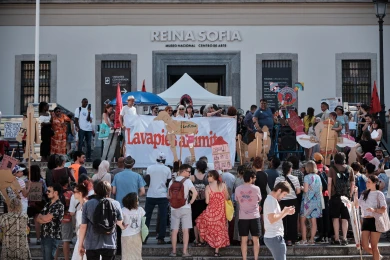
The School of Transformative Institutionalism and Local Organisation (S.T.I.L.O.) is a programme of joint learning and join strategy which sets in motion a process for the exchange of questions, methodologies and experiences between cultural organisations. The overall aim is to create, circulate and prototype tactics, tools and collective knowledge on institutional practices that open new channels for defending culture and advocating structural transformation in divergent geographical contexts.
The project is part of the Laboratorio de Institucionalidad Compartida (The Laboratory of Shared Institutionalism, LIC), a space for the Museo Reina Sofía’s research, work and advocacy centred on developing, experimenting with and systemising practices, protocols and tools which contribute to a fairer and more liveable cultural ecosystem.
For many years now, so-called infrastructural critique in museums questions material, legal and economic infrastructures, among others, as well as the forms of solidarity and practices required to sustain the cultural ecosystem. By approaching current debates, S.T.I.L.O. raises questions on the ways in which organisations define and interpret their practices, organise their relations and respond to the social contexts in which they operate.
The school gathers four cultural organisations that work via different institutional models – scale, contexts, conditions, different working models — with the goal of pooling common strategies and tools of organisation, advocacy and relationships with local communities.
The programme is conceived as a collaborative process with the participation of Arika, La Revuelta, BAK Basecamp and The Tentacular Museum (Museo Reina Sofía) and is structured around preparatory online sessions and an in-person seminar in Madrid.
S.T.I.L.O. is an activity framed inside the working strand of Situated Organisations from L'Internationale’s Museum of the Commons project, which reflects on the role of museums and art organisations as actors within complex social networks and ecosystems, with a view to exploring new ways to democratise institutions and make them more open, inclusive and useful.